There were 40,483 marriages registered in Scotland in 1950. Images of these entries are now available to search and download on our website. This forms part of the New Year record release which also provides online access to births from 1925 and deaths from 1975.
The majority of marriages that year were those solemnised by a minister of religion; 33,084 preceded by Banns or Publications of Notice. Civil marriages accounted for 6,816 of the total number, with the remaining being authorised by a Sheriff’s license or were classed as irregular marriages. Compared to the previous year, there were 1,225 fewer marriages, and couples who chose to get married preferred the months of March, June, July and September . [Source: 96th Annual Report of the Registrar General for Scotland, 1950, page 12]
One of the marriages in September 1950 was between Prince Georg of Denmark and Anne, Viscountess Anson. This took place on 16th September 1950 at Glamis Castle in Angus, Scotland.
The Groom
Prince Georg Valdemar Carl Axel of Denmark was born on 16th April 1920 in Bernstorff Palace, Gentofte, Denmark, the summer residence of his grandfather Prince Valdemar. His parents were Prince Axel of Denmark and Princess Margaretha of Sweden. His only sibling, Prince Flemming, was born on 9th March 1922 in Sweden. In 1949, Prince Flemming renounced his rights to the throne due to undertaking an ‘unequal marriage’ with Danish-born Alice Ruth Nielson, and took the title of Count of Rosenborg.
As a young man, Prince Georg received a military education at Jægersborg Barracks. He began his military career in Denmark’s Royal Life Guards ‘Den Kongelige Livgarde’, a regiment of the Danish Army that serves as both a combat troop and a ceremonial guard unit for the Danish monarchy, serving during World War Two. In 1943, he was taken prisoner by the German Army after a resistance battle at Jægersborg Barracks and was held in a prison camp until November of that year. In 1945, he was attached to the International Red Cross and worked in the repatriation of concentration camp prisoners in Germany. He became a first lieutenant in 1946 before being promoted to Colonel.
The Bride
Viscountess Anson was born Miss Anne Ferelith Fenella Bowes-Lyon in Washington D.C., USA, on 4th December 1917, where her father was attaché at the British Embassy. Her parents were The Honourable John Herbert Bowes-Lyon, a brother of the future Queen Elizabeth the Queen Mother, and The Honourable Fenella Hepburn-Stuart-Forbes Trefusis, a daughter of the 21st Baron Clinton. She came to Britain in 1919 and was educated in England, France and Switzerland.
Anne was the second child born to her parents. Her elder sister, Patricia (1916-1917), had died in infancy five months before Anne was born, and she was followed by three sisters; Nerissa (1919-1986), Diana (1923-1986) and Katherine (1926-2014). Their father died on 7th February 1930 after contracting pneumonia, leaving four young daughters in the care of his wife. Nerissa and Katherine were born with developmental disabilities and were unable to talk. From 1941 they lived at Earlswood Hospital in Surrey, England.
On 28th April 1938, Anne married Major Viscount Thomas Anson (1913-1958), Grenadier Guards, heir apparent to the 4th Earl of Lichfield. They married at St. Margaret’s, Westminster, with King George VI and Queen Elizabeth in attendance.
They had a son, Thomas Patrick (1939-2005), who became 5th Earl of Lichfield after the 4th Earl’s death in 1960, and was a notable photographer. A daughter, The Honourable Elizabeth Georgina, (1941-2020), was born two years later. She married Sir Geoffrey Shakerley, 6th Baronet, and became a party planner for members of the royal family and celebrities.
The marriage was dissolved in 1948.
During the Second World War, Viscountess Anson served in the Voluntary Aid Detachment as a nurse, using the name ‘Miss Lyon’. She also served with the Women’s Voluntary Service and the Young Men’s Christian Association, which provided essential aid such as food, drink, recreational and educational facilities to soldiers and civilians.
Prince Georg and Viscountess Anson met in 1949 when attending a Shrovetide ball at the Swedish Embassy and were seen together frequently before their engagement was announced. At that time, Prince Georg was the Danish Military Attaché in London.
The wedding
In the two days preceding the wedding, guests began to arrive at Glamis Castle, where the wedding was to be held. Amongst the attendees were Prince Olaf, Crown Prince of Norway, and his daughters Princesses Ragnhild and Astrid; Princess Josephine Charlotte of Belgium and Count and Countess Flemming of Rosenborg. The Count, brother of Prince Georg, was the best man. The groom’s parents, Prince Axel and Princess Margaretha, arrived at Aberdeen by train and travelled to Balmoral Castle by royal car.
The wedding was officiated by the Reverend Morgens Buch, chaplain at the Danish Seaman’s War Memorial Mission at Newcastle-on-Tyne. As the bride had been married before, she could not be married again by either the Church of England or the Episcopal Church of Scotland rites. The Danish Church, however, gave its ministers discretion in marrying divorced persons, and so allowed the Reverend Morgens Buch to perform the ceremony. The Canon H. G. G. Rorison, Chaplin to the Earl of Strathmore had given the Bishop of St Andrews an assurance that he would not marry the couple and would only assist by reading the lesson (a chosen passage of scripture from the bible to the assembled guests) if requested to do so.
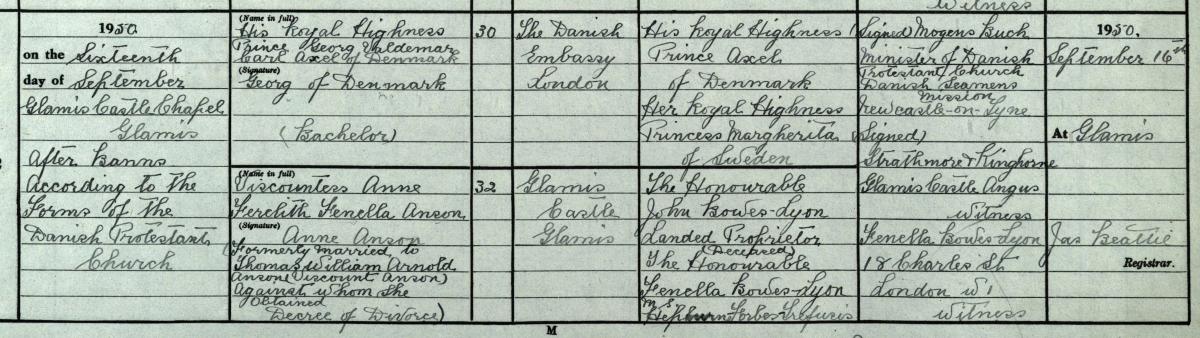
Crown copyright, National Records of Scotland (NRS), Statutory Register of Marriages, 1950, 289/2 page 1
The wedding was held in the Chapel of Glamis Castle on Saturday 16th September 1950.
The bride wore a full-length dress of mist blue and silver brocade, with a close-fitting bodice and a deep V-neckline , a matching feathered hat and she carried a bouquet made from white stephanotis, orchids, and lapageria. There were no bridal attendants, although one of her sisters, Miss Diana Bowes-Lyon, was present.
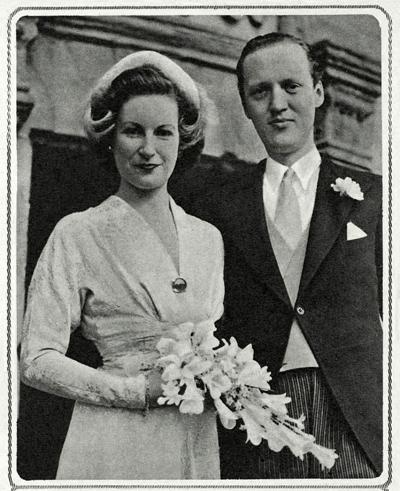
© Illustrated London News/Mary Evans Picture Library
The marriage was classed as a ‘morganatic marriage’; one in which there is unequal status in rank. Anne was not a Princess and was a divorcee. In 1950, the marriage would normally have resulted in Prince Georg losing his title and place in the line of succession for the Danish throne, as had happened to his brother the previous year. It is thought, however, that due to Anne being a niece of Queen Elizabeth, an exception was made. Upon marrying Prince George she became known as Her Highness Princess Anne of Denmark. Prince Georg later lost his place in succession following the Act of Succession of 1953, which restricted the Danish throne to those descended from King Christian X and his wife Alexandrine of Mecklenburg-Schwerin, through approved marriages.
Queen Elizabeth and her daughter Princess Margaret arrived at Glamis Castle for the reception and luncheon which followed the ceremony. As the bride was a divorcee, the Queen had been advised not to attend the wedding, but to arrive for the remaining celebrations. The Queen wore a powder blue dress and coat with fox stoles and a blue hat trimmed with osprey feathers. Her outfit was accessorised with a triple string of pearls and a diamond brooch. Princess Margaret wore a long-fitting coat of dusty pink, dark gloves and hat to match, a row of double pearls and a pearl and diamond spray.
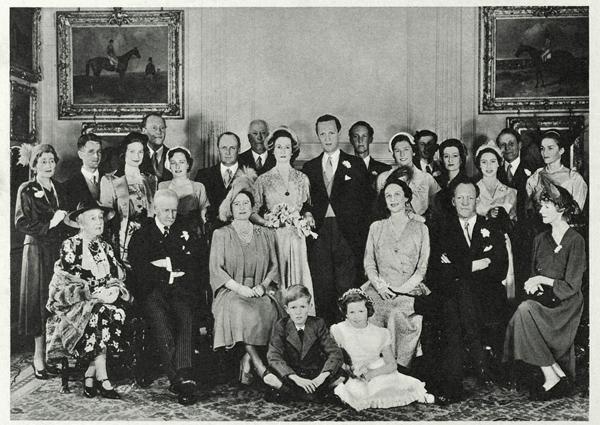
© Illustrated London News/Mary Evans Picture Library
Following the wedding, Prince Georg continued to serve as military and defence attaché at the British Embassy. The couple based their time between Denmark and, at first an apartment in London next door to Prince Georg’s office, before moving to Broadfield Hall in Hertfordshire, England where they lived from the early 1970s. They took an active interest in their local village of Cottered, where the Prince was president of the Cottered Horticultural Society for over 14 years.
In 1975, he was made Honorary Colonel of the 5th (Volunteer) Battalion of the Queen’s Regiment. Links between the Regiment and the Royal House of Denmark were established almost 300 years earlier through The Buffs, one of the founder regiments of the Queen’s Regiment. The Danish Queen Margrethe II, the niece of Prince Georg, was Allied Colonel-in-Chief of the Queen’s Regiment at the time of his death. His honours included Knight Commander of the Royal Victorian Order (recognising personal service to the British monarch or members of the royal family) and Knight of the Order of the Elephant (a Danish order of chivalry and Denmark’s highest ranked order). Princess Anne supported her husband in hosting events at home and joining him when he travelled to Denmark as the attaché to the King, becoming almost fluent in Danish. She last visited Denmark in April 1980 when Prince Georg celebrated his 60th birthday.
Princess Anne died on 26th September 1980, aged 62, in London, from a heart attack. Her body was brought to Copenhagen, and her funeral took place at the Anglican St Alban’s Church on 6th October, attended by Queen Elizabeth II, Queen Elizabeth the Queen Mother, King Olav V of Norway and Queen Ingrid. Prince Georg died in Copenhagen on 29th September 1986, aged 66. He was buried with his wife at Bernstorff Palace, Denmark, where he had been born.
Further reading and sources
Belfast News-Letter, Saturday 16th September 1950
Nottingham Evening Post, Saturday 16th September 1950
The Sketch, Wednesday 27th September 1950
A profile of Anne Bowes-Lyon on the History of Royal Women website