The National Records of Scotland (NRS) holds the official records of the vital events of our lives. Every January, the records of people who were born 100 years ago, married 75 years ago or died 50 years ago in Scotland are added to our website.
The entries of people who were born in Scotland in 1925 are now available to search and save on Scotland’s People. They are part of 239,967 entries released in January 2026 which include deaths registered in 1975 and marriages registered in 1950.
In 1925, a total of 126,837 living children were registered in Scotland. Of this number, 53,426 were male and 50,711 were female. The total number of births registered during the year was 2,763 fewer births than in 1924. This was the smallest number of births registered in Scotland in any year after 1858, except for 1917 and 1918 which were affected by war conditions. The highest number of births registered in Scotland before 1925 was in the year 1920 with 136,546. (Source: Registrar General’s Report of 1925 pages xi)
One of the babies born in 1925 was Catherine McIntosh Rankin. She would become better known as Kay Carmichael, an activist, central figure in the history of social work in Scotland, policy adviser and lecturer. Kay was born at 42 Calder Street, Glasgow, on 22nd November to parents John Dawson Rankin, a postal telegraphist, and Mary Patricia Price, a midwife.
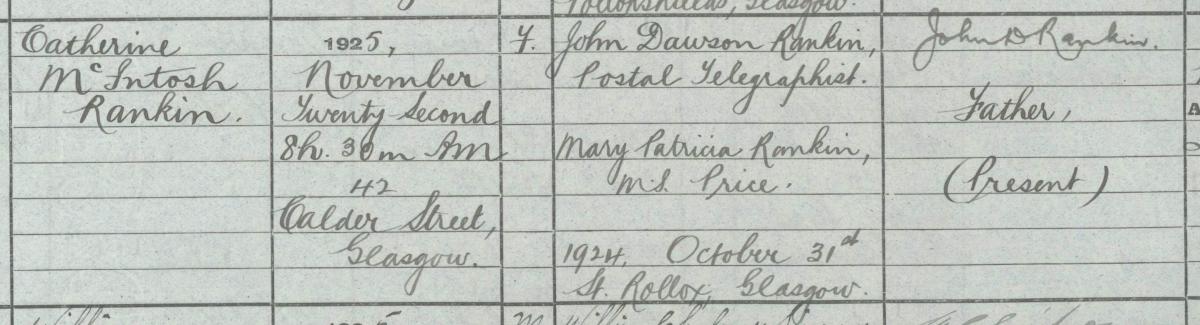
Crown copyright, NRS, Statutory Register of Births, 1925, 644/18 893 page 893
Kay had a challenging childhood. She grew up in an impoverished area of Glasgow, and, at the age of four, contracted polio. Although she eventually regained most of her movement, she never recovered the full use of her left arm. She was a curious child and enjoyed reading and learning, often spending time in her local library. She was educated at a convent school in Govan, Ayrshire, and, during the war, was evacuated to Dumfries.
Between 1955 and 1957 Kay completed a Certificate in Social Study at The University of Glasgow, followed by a Psychiatric Social Work course at The University of Edinburgh. Her work centred around girls in borstals (a prison for offenders too young to be held in a regular prison) where she developed improved rehabilitation plans for offenders. Almost two decades later, in 1973, she helped to set up the Special Unit at Barlinnie Prison, Glasgow. This housed some of Scotland’s most dangerous male prisoners and, working there one-day-a-week, she sought to improve the relationship between prisoners and staff.
In the 1960s, Kay developed social work policies. She was part of the Kilbrandon Committee which produced recommendations on ways to support children who had either committed crimes, were in care or who needed protection from their circumstances. The report that was produced, titled ‘Children and Young Persons, Scotland’, was presented to Parliament in April 1964. It formed the basis of the Social Work (Scotland) Act 1968 which established a community-based social work service in Scotland and led to the creation of the Children's Hearing System. This was a landmark moment in legislation to support young people in Scotland.
Kay was also an active member of the Labour Party for many years. She joined the party in 1945 and later became a part-time member of Prime Minister Harold Wilson’s policy unit at number 10 Downing Street. Her first husband, Neil George Carmichael, was a Labour Member of Parliament (MP) in Glasgow from 1962 to 1983. He was created a life peer as Baron Carmichael of Kelvingrove in October 1983.
The couple had married in St Mark’s Church, Glasgow, on 2nd April 1949. In June of the same year their daughter Sheena was born. The Carmichaels divorced in 1977.
As part of her involvement in the Labour Party, Kay energetically campaigned for the rights of minority groups and against nuclear weapons. She was imprisoned for 14 days in 1986 in Corton Vale women’s prison when she refused to pay a fine for breaking into the Faslane nuclear base (officially named HM Naval Base Clyde) and joining a demonstration. She was a proud founding member of the self-styled Gareloch Horticulturists, or "Horts" for short; women who would stage "guerrilla" raids into the Faslane base, armed only with vegetable or flower bulbs. Throughout her life she was a regular visitor to the "peace camp" which was found among the trees near to Faslane.
Kay left the Labour Party in 1994 when Tony Blair was elected leader. She later joined the Scottish Socialist Party before moving to the Scottish National Party.
In 1977 Kay spent three months living in Lilybank, a small housing scheme in the east of Glasgow. At that time, Kay was deputy chairman of the supplementary benefits commission and moved to Lilybank with the purpose of understanding and experiencing the ways in which people were surviving on very low incomes. As part of this process, Kay was filmed by hidden BBC cameras. When the resulting programme, ‘Lilybank: The Fourth World’, was aired, the local community were upset by the way the area was portrayed. It has been thought, however, to have contributed to an increase in the rise of benefits for struggling families across the UK.
In 2001, Kay graduated from the University of Glasgow at the age of 76 with a PhD. Her thesis was titled ‘ A Post-Christian Perception of Sin and Forgiveness’.
Kay married for a second time, in Dunoon, in 1987. Her husband, David Vernon Donnison was an academic and social scientist, and had previously been married to historian Jean Kidger; they separated in 1979. Together they had five children.
Kay died in Glasgow on 22nd December 2009, aged 84. In 2017, her husband edited and published a collection of her writings titled ‘It Takes a Lifetime to Become Yourself: A Collection of Writings.’ He died the following year, aged 92.
Further reading and sources
Profile of Kay Carmichael on Social Work at Edinburgh University
Profile of Kay Carmichael on Glasgow Science Festival website
Kay Carmichael's obituary in The Guardian
Kay Carmichael's obituary in The Scotsman