- The Scottish Church - a (very) brief history
- Disruption
- Free Churches and their construction
- Opposition
- References and further reading
We have added over 1100 new records covering 262 congregations to Virtual Volumes. This release adds to the fascinating collection of records from Presbyterian churches already available. Guidance on accessing these records has been added to the Church Court Records guide and the Virtual Volumes guide. For a list of United Presbyterian, Free, United Free and other presbyterian congregations from which records are included in this release, please see Church Court Records online.
The records are mainly those of the kirk sessions, presbyteries and synods covering the dates 1739-1900 (those falling under the archive reference CH3). These records include kirk session minutes, accounts and cash books, communion rolls, deacons’ court minutes, seat rents and more. In this article we explore what these records can tell you about a place and its people, and what they reveal about some unique events in Scottish history.
The Scottish Church - a (very) brief history
The Church of Scotland was at the heart of Scottish life well into the late 19th century. A major change to the running of the church occurred in 1560 when the Protestant Church in Scotland broke from Rome; this was a political revolution which removed the Pope’s authority in Scotland. For the next 130 years the Scottish Church was split by supporters of two competing forms of church government: presbyterianism (government of the Church by its local elders) and episcopalianism (government of the Church by bishops). In 1690 prebyterianism prevailed and became the official state religion, also known as the ‘Established Church’.
The administration and record keeping of the presbyterian church is conducted by a hierarchy of church courts.
The General Assembly
The highest court and the governing body of the Church of Scotland which meets annually in Edinburgh.

Synods
Presbyteries were grouped into synods. Synods met mostly twice a year and could hear appeals against decisions from presbyteries. Synods were comprised of both ministers and representative elders who were on the rolls of the presbyteries within the synods. The main officials were a moderator, a synod officer and one or more clerks. They examined presbytery records and reported to the General Assembly on matters such as special visits to congregations (if required) and supervision of general schemes of the Church. Synods were reviewed and dissolved from 1 January 1993.
Presbyteries
Each presbytery superintends the kirk sessions and ecclesiastical activity within its boundaries. It also elects ministers and elders to attend the General Assembly. As a court, presbyteries have the power to review decisions taken by kirk sessions or congregations. Membership comprises ministers, certain elders and (from 1990) members of the diaconate within its bounds. Presbyteries meet approximately once per month.
Kirk Session
The kirk session is the lowest, local parish court of the Church of Scotland. Composed of elders of each congregation, it was presided over by its minister acting as a moderator.
Responsible for the moral wellbeing of its parishioners, as well as certain aspects of civil administration, such as education and poor relief, these records can be a treasure trove of family and social history. Among the things you might find are:
- A significant number of minutes on what was considered to be unacceptable behaviour. The kirk session was concerned with the moral wellbeing of its congregation, and where there was a perceived breach of conduct, it issued punishments. These could include rebukes and fines for fornication, antenuptial fornication, breaking the sabbath, irregular marriage and drunkenness.
- Certificates of transference – issued from the previous parish of residence to grant admittance to the congregation at a new location. Although few certificates survive, references within the kirk session minutes can provide evidence of a family’s movements.
- Records of poor relief.
- Records of running schools and employing schoolmasters.
- Records of extraordinary events such as war, a poor harvest, disease and in this case disruption….
Disruption
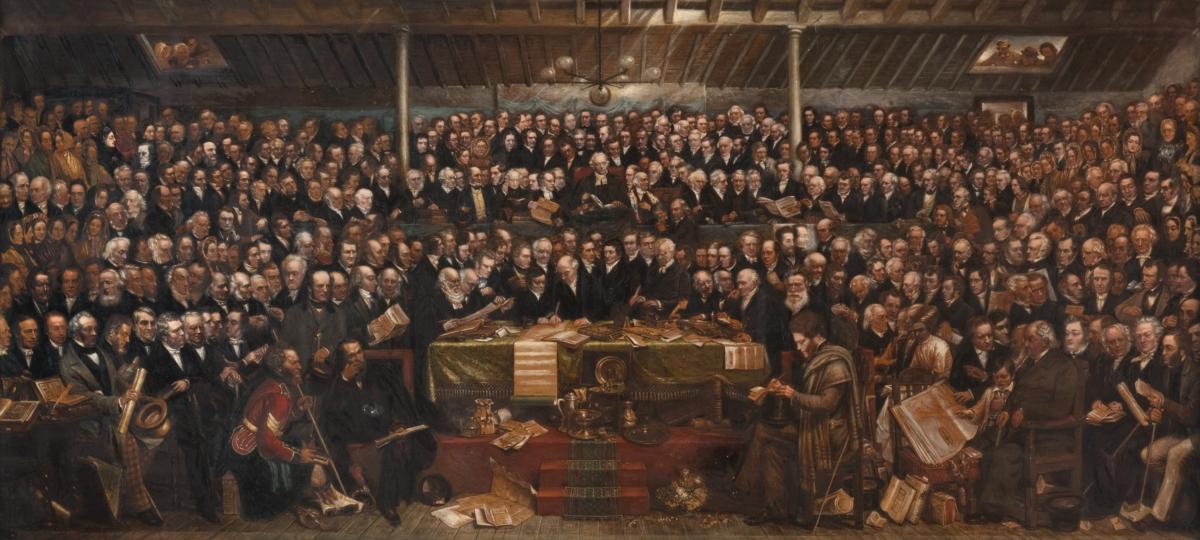
© The Hunterian, University of Glasgow
Unique within this recent release are records of the events following the Great Disruption. A schism that developed and finally split in 1843, the Disruption was a conflict, perhaps primarily, over who had the power to control clerical positions and benefits. On 18 May 1843, the day on which the General Assembly was due to open, the retiring moderator produced a protest signed by 203 of the assembled commissioners. He announced that they were withdrawing from the Assembly to separate from the Established Church, an act forced on them by interference in the Church’s affairs. The seceding minsters were led out of St Andrew’s Church in Edinburgh and along George Street to Tanfield Hall at Canonmills, where the first Free Assembly was held. In time, some 470 evangelical ministers broke away from the Church of Scotland and went on to form the Free Church of Scotland.
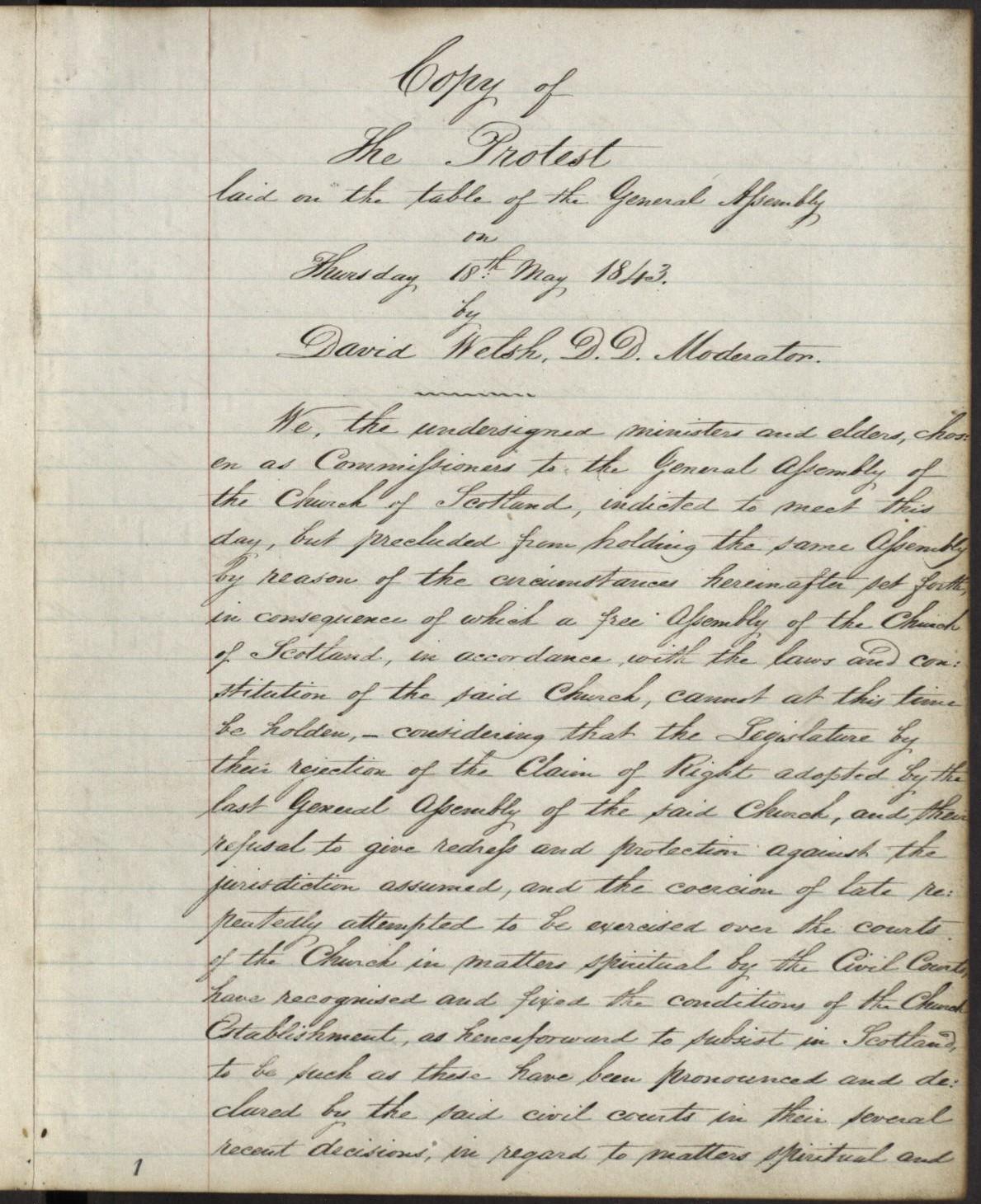
NRS, CH3/965/1 page 1
The Free Church of Scotland later fractured further into a number of secession churches – see Church court records – before 1929 when the United Free Church (formed from many of the seceding churches’ congregations) rejoined the Church of Scotland. When researching an area or church it is essential to consult these records under the reference CH3, and those under the reference CH2, as pre-1929 and post-1929 records of a church may be split.
Within a few years of the creation of the Free Church of Scotland, no fewer than 500 Free Churches were built. By the end of the 19th century there were often several places of worship in a single parish, often in close proximity.
A ship while sailing past a remote island, discovered a man who had been stranded there for several years. Setting ashore to rescue him, they found the man had built three huts for himself.
They asked: “What is the first hut for?”
He said: “That’s my house”
They asked: “What’s the second hut for?”
He said: “That’s the church I go to”
They asked; “Ok, so what’s the third hut for?”
He said: “oh, that’s the church I don’t go to"
Unlike the ‘established church’, the Free Church of Scotland did not benefit from the financial support of the state. Ministers forfeited their living, manses and pulpits and the work of financing a new church had to begin from scratch. Many of the records released to Scotland’s People contain details of the formation of these new churches, including the building’s construction, the contribution of congregation members and some of the difficulties encountered.
Free Churches and their construction
Some church records reveal the contributions made by families. This might be in the form of money, or potentially labour. Within the records of the Deacons’ Court of the Free Church of Scotland in Auldearn, we find different tradesmen from within the congregation offering their services. Masons were organised to assist in building the wall surrounding the church, and farmers engaged to move the necessary stone from quarry to the building site.
“…it being understood that the masons belonging to the congregation would assist in building the said wall and hewing the freestone in the season of winter when they were not otherwise employed, by which means the expense would be greatly diminished…” (NRS, CH3/32/2 page 17)
With a bit of searching it may be possible to identify your ancestor and their role within the community, as tradesmen can be named in the minutes.
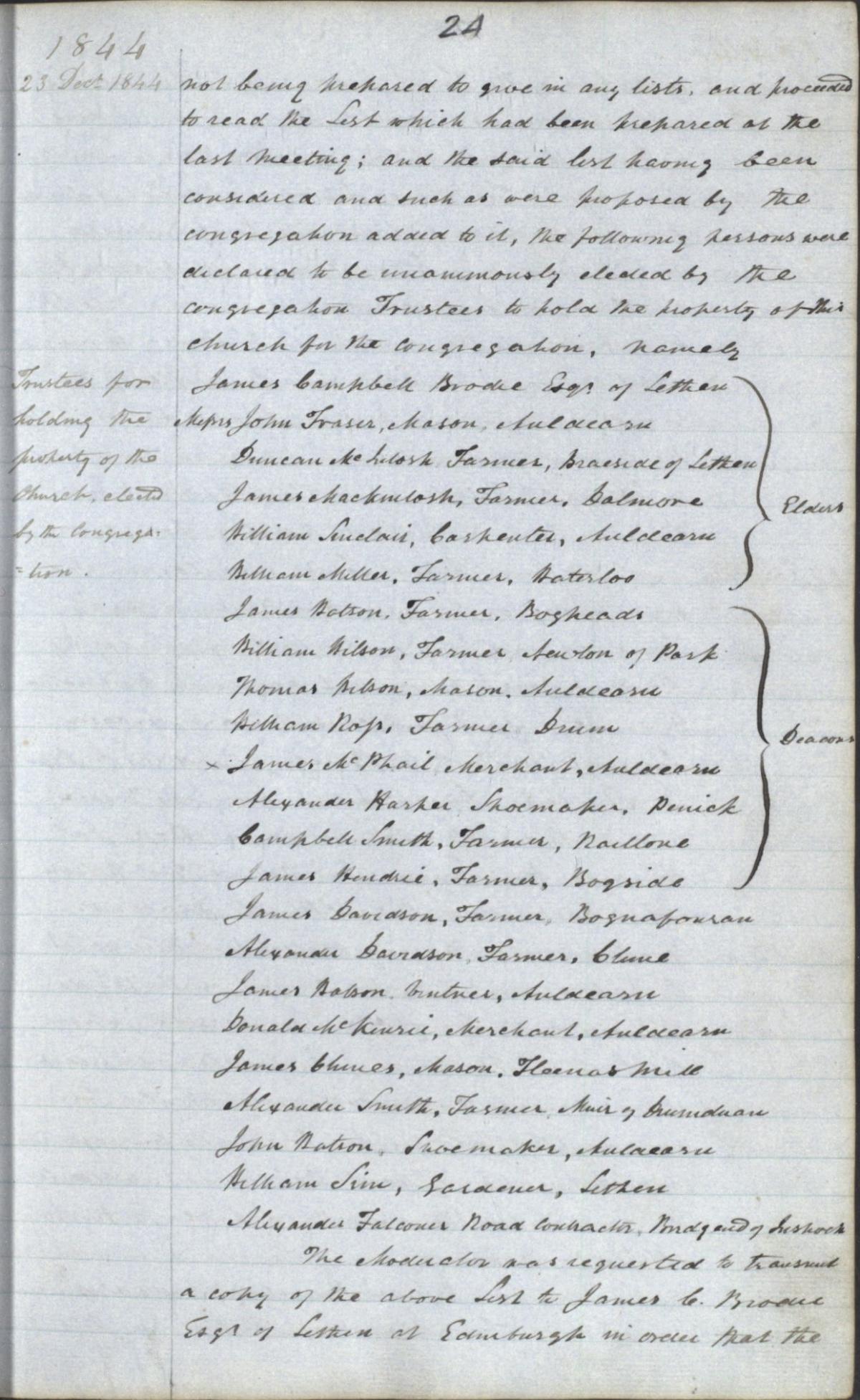
NRS, CH3/32/2 page 24
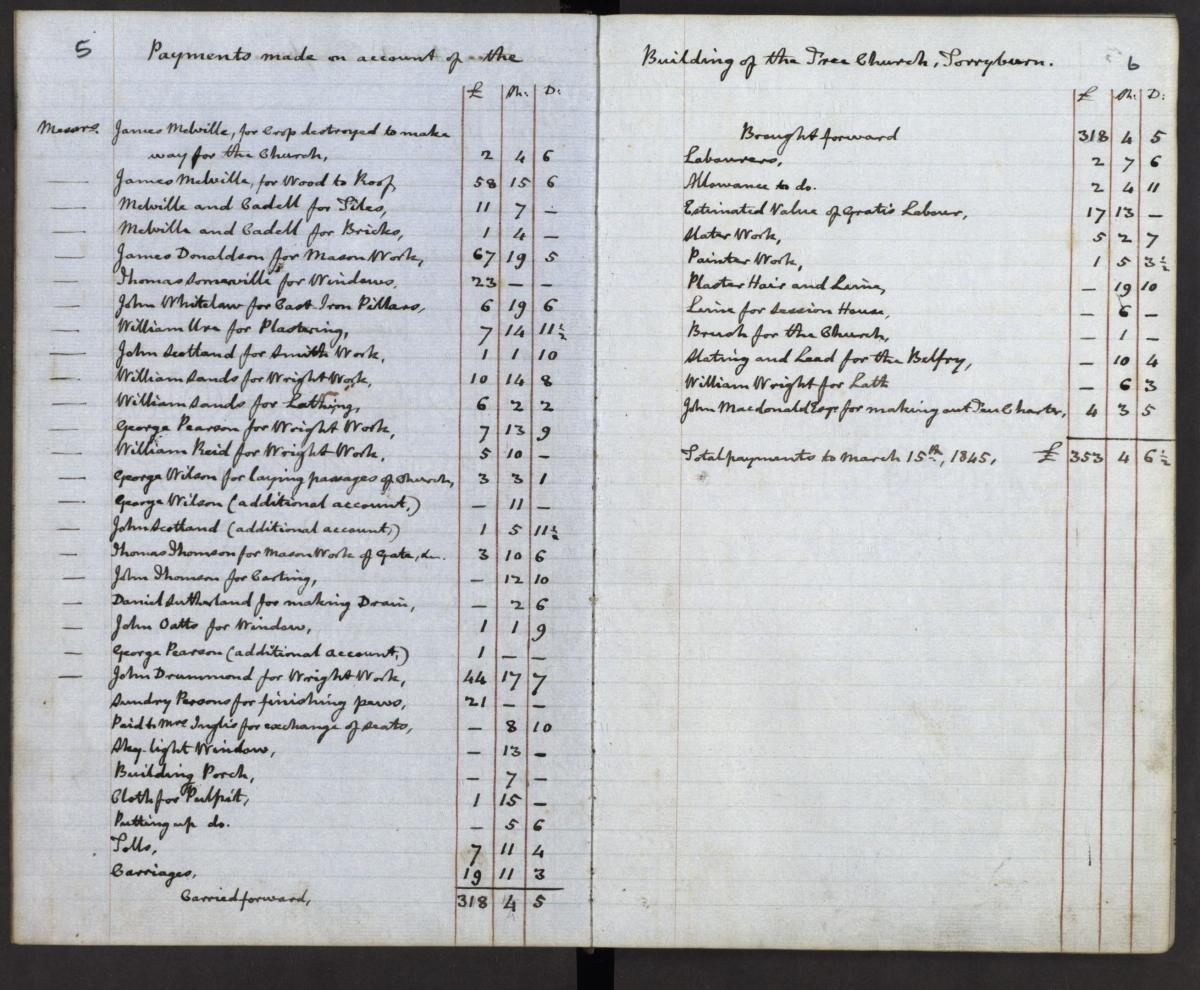
NRS, CH3/297/3, p5 and 6
Prior to the mid-20th century it was common for churches to have seat or pew rents that secured a fixed seat for individuals. As Free Churches were constructed, the allocation of seats was also recorded, with more prominent positions (near the front) being given to those that contributed the most to the building’s construction.
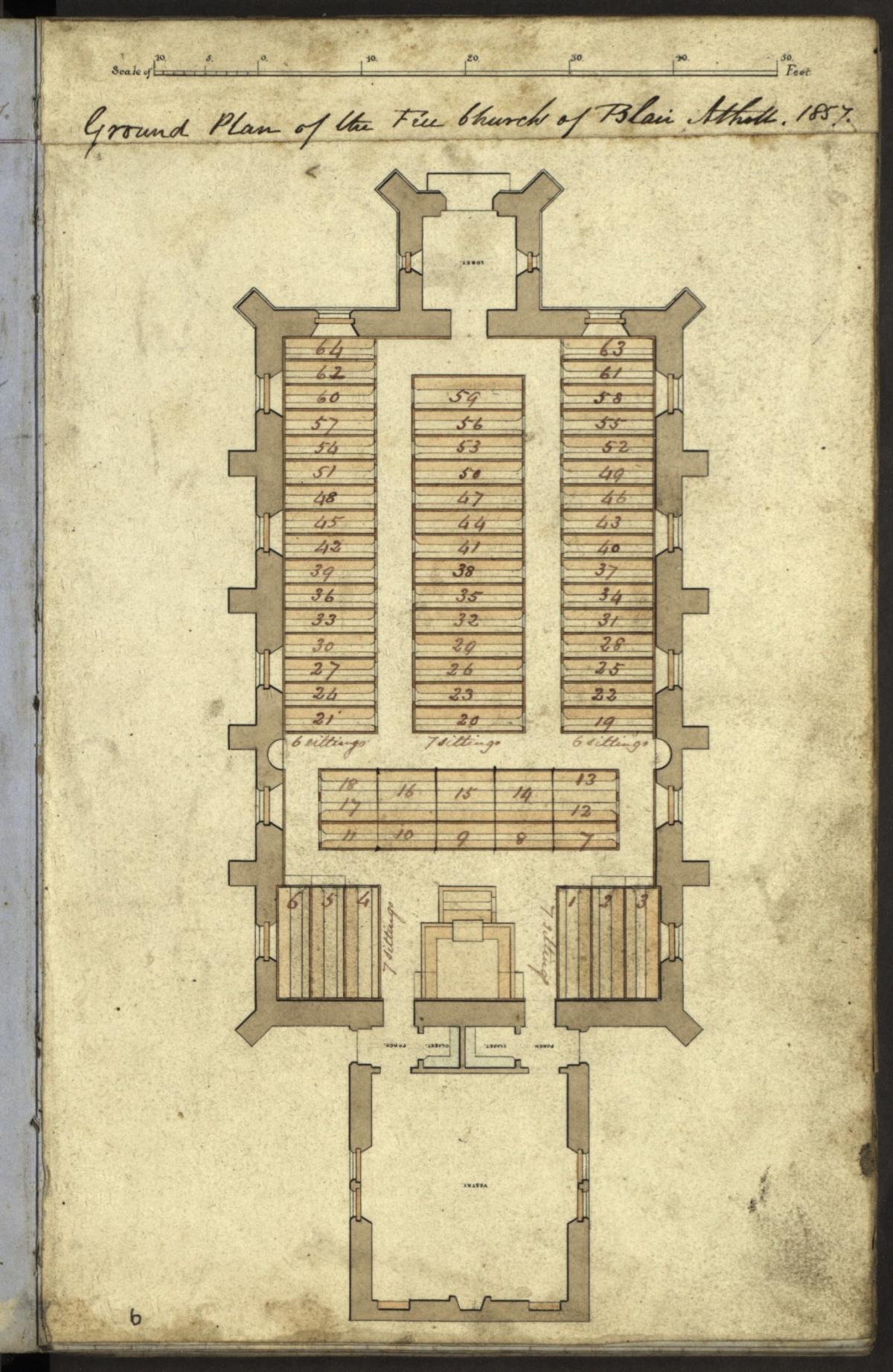
NRS, CH3/358/4 page 6
These records allow you to trace not only how much your ancestors were able to contribute – and therefore hazard a guess at their mode of living – but even where they sat. Unusually, the records of the Blair Atholl Free Church include a ground plan within the Seat Letting Book.
Opposition
Outside of the expense, many Free Churches faced the hostility of landed proprietors. Without their goodwill, access to a suitable site for a church’s construction could be difficult, if not impossible to find.
A famous example is the Free Church of Strontian; refused a site by the landowner Sir James Riddell, contemporary sources record the proposal of a floating church.
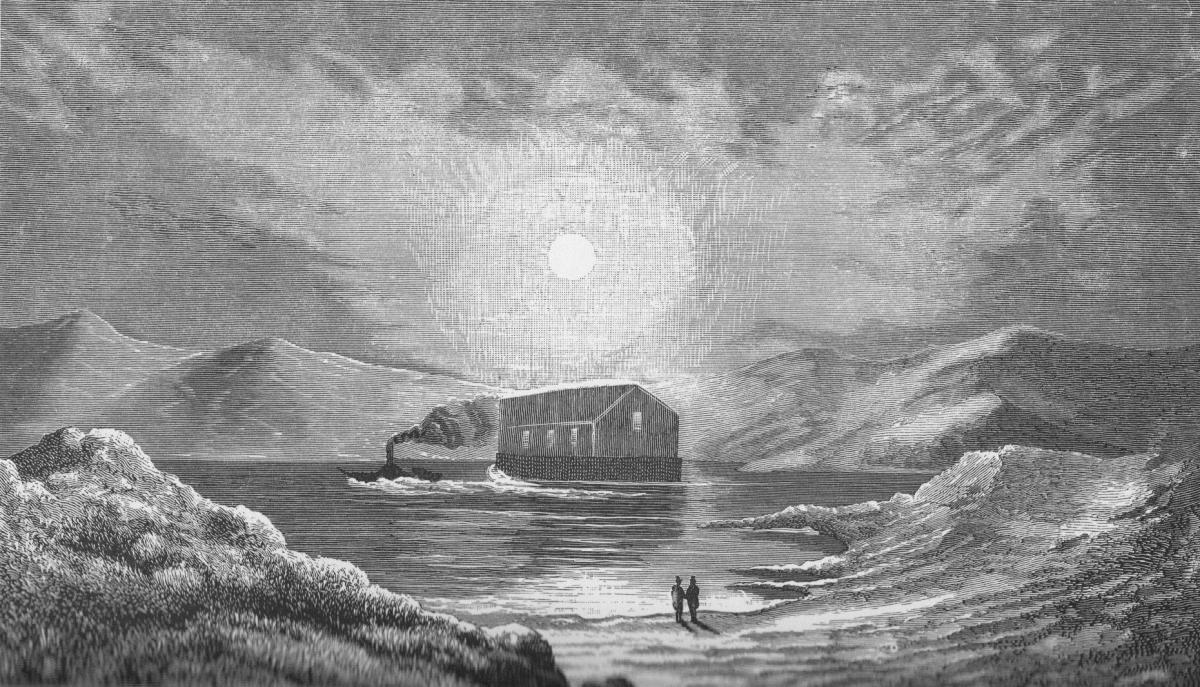
Public domain, via Wikimedia Commons
“A floating church was proposed, which might be anchored in some sheltered bay near the beach, and given accommodation to the people till better days came round”
A contract was placed with Mr John Wood of Port Glasgow for an iron church and it was constructed in the building yards of Clyde under the superintendence of Robert Brown, Esq. of Fairlie. Unfortunately, although references can be found to the church, it’s construction and subsequent mooring(!), the records of the church itself do not seem to have survived.
The stories of difficulties in acquiring a site were not uncommon. On 14 May 1855 the St Andrews Free Church wrote to Mr McInroy, the Laird of Lude about acquiring a site. They explained their position and the lack of assistance from the 6th Duke of Atholl in permitting a site:
“…That the suitable building on the Island of Kinglass erected for the temporary accommodation of the people is decaying rapidly….that repeated applications for a site & which he has every instance positively refused to grant, have been made to the Duke of Atholl. His reply to a most respectful application upon this subject in the course of last year was “certainly not”…” (CH3/358/1 page 129)
With conditions agreed upon, the Laird of Lude provided ground and the St Andrews Free Church was completed in 1857.
Through these records you can investigate not only individual lives, but the events and community of a local area. These records are now available on Scotland’s People and can be browsed freely. Guidance on accessing these records is available here, and further resources are linked to below.
References and further reading
- Brown, T. 1892. Annals of the disruption: with extracts from the narratives of ministers who left the Scottish establishment in 1843. Edinburgh: Macniven & Wallace [Accessed 8 June 2026]. Available from: https://archive.org/details/annalsofdisrupti1892brow/page/426/mode/2up
- Coast. [No date]. The Floating Church on Loch Sunart. [Accessed 8 June 2026]. Available from: https://coast.scot/stories/the-floating-church-on-loch-sunart/
- Kerr, J. 1998. Church and Social History of Atholl. Perth: Perth & Kinross Libraries
- Maclean, C. 1997. Going to Church. Edinburgh: National Museums of Scotland
- Mull Historical & Archaeological Society. [No date]. Lochdon Free Church. [Accessed 8 June 2026]. Available from: https://mull-historical-society.co.uk/churches/churches-2/lochdon/
- Ritchie, L.A. 1985. The Floating Church of Loch Sunart. Scottish Church History Society [Accessed 8 June 2026]. Available from: https://archive.org/details/rschsv022p2ritchie/page/160/mode/1up
- Withrington,D.J. 1993. The Disruption: a century and a half of historical interpretation. Scottish Church History Society [Accessed 8 June 2026]. Available from: https://archive.org/details/rschsv025p1withrington/mode/1up