Introduction
The Reverend John Witherspoon (1723-1794)
James Wilson (1742-1798)
Further reading and sources
Introduction
The 4th July 2026 marks the 250th anniversary of the Declaration of Independence officially being adopted by The Continental Congress. The Declaration separated 13 British colonies from ties with Great Britain, resulting in 13 independent separate, sovereign states.
Almost a month later, on 2nd August 1776, it was signed by 56 delegates. Although this did not create The United States of America (which was established in 1787 when a federal government was created), it was the first monumental and important step towards creating the country that we know today.
Amongst the delegates who signed the Declaration were nine men of Scottish origin. Two signatories were born in Scotland: The Reverend John Witherspoon and James Wilson.
This article looks at the Scottish roots of these two men who played a pivotal role in America’s independence.
The Reverend John Witherspoon (1723-1794)
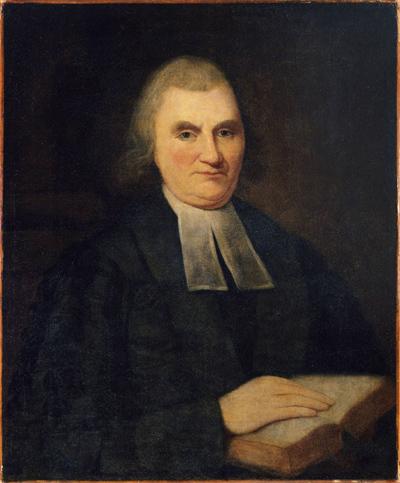
Courtesy of Princeton University, gift of friends of the University (PP19)
John Witherspoon was born in Yester, East Lothian, Scotland, to James Witherspoon, the ‘minister of the Gospel’ in that parish, and his wife Anne Walker. Anne’s father, David Walker, was also a minister, based in the parish of Temple, near Edinburgh. James and Anne had married three years earlier on 21st October 1720 in Yester.
Witherspoon’s baptismal record, dated 10th February 1723, appears in the Old Parish Register (OPR) for Yester, East Lothian.
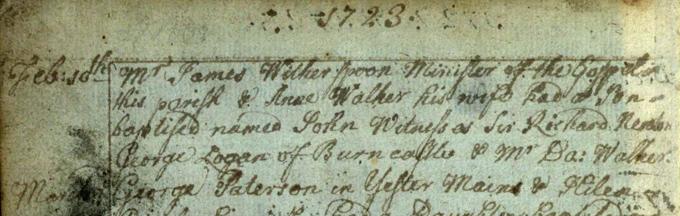
Crown Copyright, National Records of Scotland (NRS), OPR of births and baptisms for the parish of Yester, 725/10 page 308
Witherspoon enjoyed a comfortable childhood in a modern manse, which was built around 15 years before his birth. As a young boy, he took pleasure in fishing and playing with friends and benefited from a solid education. He attended Haddington Grammar School, a four mile walk from his home in Gifford, where he was taught Latin, mathematics, grammar, writing and singing alongside instruction in religious scriptures.
At 13 years old he began his studies at The University of Edinburgh. His matriculation is recorded on 26th February 1736, four months after the beginning of term in November 1735. Witherspoon was said to be a studious, serious young man by contemporary accounts. During his time in Edinburgh he lived in lodgings in the Lawnmarket. This was preferable to the experience of poorer students who lived in the main quadrangle of the university and had to bring their own supply of oat and barley meal to eat over the cold winter.
On 23rd February 1739, in the university common hall before a large audience, 16-year-old Witherspoon defended his 12-page dissertation ‘De Mentis Immortalitate’ (Latin for ‘On the Immortality of the Soul’) which he dedicated to the Marquis of Tweeddale, the patron of his father’s parish. Three days later he was laureated Master of Arts.
The next autumn he continued to study theology at the University of Edinburgh. During this time, he formed an attachment to Miss Anna Hogg. Although they became close, they did not marry, but maintained a friendship, writing regularly until Witherspoon’s death.
Witherspoon was said to have had little patience for his fellow student’s liberal views and with clergymen who had interests outside their pastoral work. Instead, he chose to focus on developing his scholarship and good sense.
As part of his studies he had to undertake the following trials: a sermon, a lecture, a popular address, an exegesis of a passage of scripture (interpreting a passage of scripture to extract the original intended meaning, rather than from a modern perspective) and expositions of portions of the Hebrew and Greek scriptures (interpreting, explaining, and communicating the exact meaning and intent of a biblical passage).
On 6th September 1743, ‘the Presbytery took a review of all his tryalls and declared their satisfaction with them; and he having answered the questions and subscribed the Formula according to the Appointment of the Act of Assembly was licensed to preach the gospel as a probationer within their bounds.’ [Source].
The Presbytery of Irvine (in which Beith parish sat) met at Beith on 24th January 1745 to decide which man should be given the position of minister in the parish. There were two candidates: Mr George Muirhead and Mr John Witherspoon. Witherspoon was the popular choice of the congregation with a vote of 106 votes in Witherspoon’s favour (compared to 49 for Muirhead).
Interestingly, the majority of the votes from the landed classes went against Witherspoon, with the Duke of Hamilton and other heritors voting for Muirhead. However, the overall vote decided that Witherspoon would settle in the parish. Muirhead was ordained minister of Mingaff, Wigtonshire, in 1746 and within a year was promoted to the parish of Dysart in Fife.
Witherspoon was officially ordained as a minister in Beith church on 11th April 1745. He was 22 years old. The same year, he joined a march to Glasgow as part of the Jacobite Rising of 1745. As a committed Protestant, he actively supported the British Government. Witherspoon had, under the direction of the Presbytery of Irvine (in which his parish sat), urged his parish to raise volunteers for the Duke of Cumberland’s army, and he decided to join the cause himself. It is said that Witherspoon and others went to watch the battle at Falkirk, on 17th January 1746, rather than fight in it themselves; regardless of their intent, this did not end well. The Jacobites’ success led to the capture and imprisonment of fleeing soldiers and spectators, including Witherspoon. He was imprisoned in the ruinous Doune Castle.
Amongst the men imprisoned with Witherspoon was Lieutenant John Home, whom Witherspoon had known at university. His written memories of the experience tell us that in the highest part of the castle, next to the battlements, was ‘a large ghastly room’ with two small vaults or cells off one end where they were held. On the floor lay straw and blankets, which proved to be their means of escape: the men made rope from their blankets and scaled down the west side where there were no sentinel on duty.
Seven men escaped in this fashion, although Witherspoon stayed behind. Five escaped without injury, one broke his ankle and the other died of injuries after his rope broke. Witherspoon was released shortly after.
This experience badly affected his mental health for a few years and interrupted the focus on his work. His attendance at presbytery meetings was irregular during 1746, he failed to prepare a sermon which had been requested by the presbytery in 1747, and he abruptly finished some sermons, under the impression that he was dying. Overtime, he regained his earlier composure, but the effects of his capture followed him for the rest of his life.
NRS holds the kirk session minutes for Beith (NRS, CH2/31/2) which cover the years Witherspoon was minister there. They demonstrate that he conscientiously exercised discipline around the congregation’s (mis)behaviour.
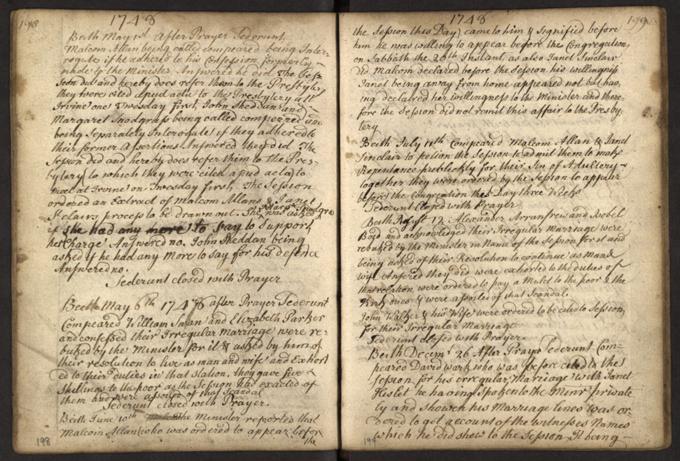
NRS, CH2/31/2 page 199
Witherspoon did not agree with irregular marriage (a legally recognised union formed simply by the mutual consent of the couple, without the need for a religious ceremony or an official officiant). The page above records examples of couples being brought before the kirk session to confess ‘their irregular marriage [and] were rebuked by the minister for it & asked by him of their resolution to live as man and wife and exhort to their duties in that station.’ Upon their agreement of the statement, the couple were instructed to make a donation to the poor. The page above also records instances of adultery; a common theme in many kirk session volumes.
Witherspoon remained at Beith until 16th June 1757, when he was called to The Laigh Kirk Parish in Paisley. He declined calls to go to Dublin and Rotterdam.
John married Elisabeth [Elizabeth] Montgomerie, the daughter of Robert Montgomerie of Craighouse, on 14th August 1748 in Beith.
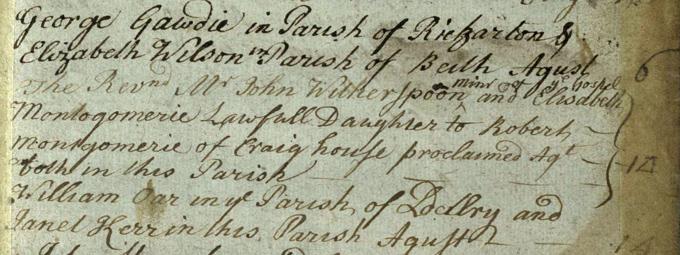
Crown copyright, NRS, OPR of marriages, Beith, 1748, 581/287 page 408.
The couple had ten children, five of whom survived infancy.
Scotland’s People records the birth of at least five of the Witherspoon children: Ann (born 1749); Christian (born 1750); John (born 1757); Francis (born 1759) and David (born 1760).
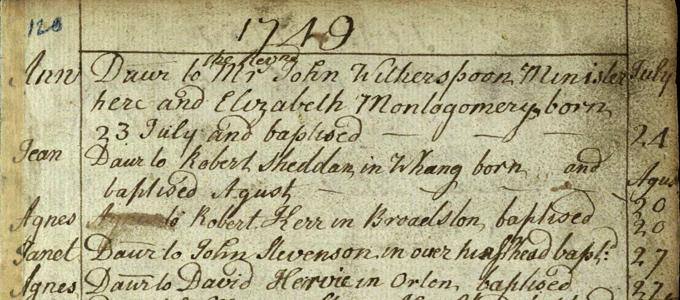
Crown copyright, NRS, OPR of births in Beith parish, 581/241 page 591
John had become acquainted with an American lawyer, Richard Stockton, and an American medical student, Benjamin Rush, during his time in Paisley. They encouraged him to emigrate and, in 1768, John travelled with his wife Elizabeth and their five children to New Jersey. There, Witherspoon accepted the Presidentship of the College of New Jersey (now Princeton) and was appointed President on 9th May of that year. He brought with him 300 books for the college library and was welcomed by students who illuminated Nassau Hall with a lit tallow dip in each window.
When the struggle for independence began, Witherspoon wholeheartedly supported the Colonies, representing New Jersey. His ardent support led the citizens of New Jersey to elect him their representative on the Continental Congress (a body which managed the American Revolutionary War and transitioned the colonies into a sovereign nation); a position which he held for seven years. The Scots Magazine, on 1st June 1955, reported that, when a member of the Congress expressed a fear that they ‘were not ripe for such independence’ Witherspoon retorted ‘In my judgement, sir we are not only ripe, but rotting!’
Horace Walpole, a politician, writer and historian (and the youngest son of the first British Prime Minister Sir Robert Walpole), on hearing of Witherspoon’s support for the colonies, quipped ‘Our cousin America has run off with a Presbyterian parson!’
On 4th July 1776 Witherspoon signed the Declaration of Independence, the only clergyman to do so. He had been instrumental in revising an earlier draft. This had contained a passage condemning King George III for employing ‘Scotch and other foreign mercenaries’; Witherspoon discreetly campaigned to have the phrase deleted.
He later became the first Moderator of the Presbyterian General Assembly in America, opening the assembly on 21st May 1789 in Philadelphia and giving the opening sermon.
Elizabeth Witherspoon died in October 1789. She was remembered as a kind, piteous and frugal woman who supported her husband throughout their marriage. Two years later, Witherspoon married again. At the age of 68-years-old, on 30th May 1791, he married 24-year-old Anne Marshall Dill. Anne was a young widow from York County, Pennsylvania. Together, they had two daughters.
Witherspoon became blind and unwell in his final years, eventually being unable to preach, lecture or write. He died, aged 71 years old, at his country estate, Tusculum, in Princeton, on 15th November 1794. Three days later he was buried in the presidents’ lot in the cemetery in Princeton.
His writings were collected and published. The first three volumes were published in Philadelphia in 1800; a fourth volume was subsequently added, and a new edition appeared in 1802. Another edition in nine volumes appeared in Edinburgh in 1815.
On 28th August 1955 a bronze bust was unveiled on the wall of Yester manse garden by The St Andrew’s Society of New York to commemorate the life of this notable Scot.
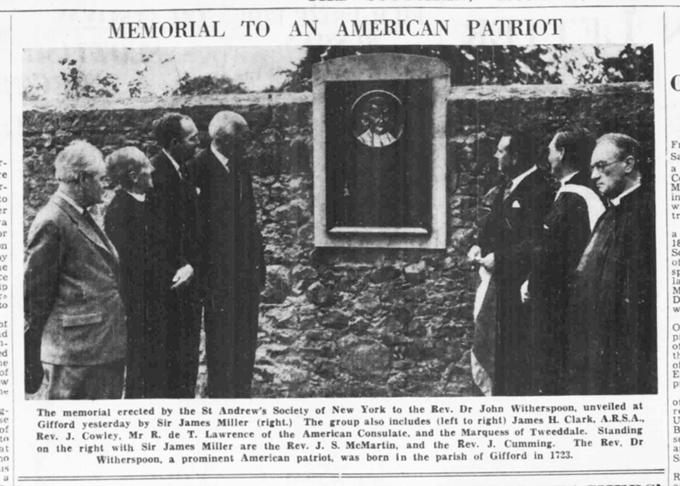
Courtesy of The Scotsman.
James Wilson (1742-1798)
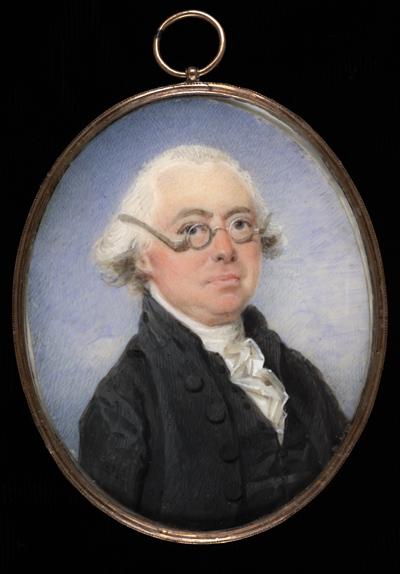
Watercolour on ivory, 6.7 x 5.2cm oval, Smithsonian American Art Museum, Museum purchase through the Catherine Walden Myer Fund, 1952.3.3
James Wilson was born on 14th September 1742 on the farm of Carskerdo, near Ceres, in Fife, the eldest son of William Wilson and his wife Alison Lansdale. They had married in Fife on 8th March 1734.
Wilson’s baptism is recorded in the OPR of Largo on 4th June 1743.
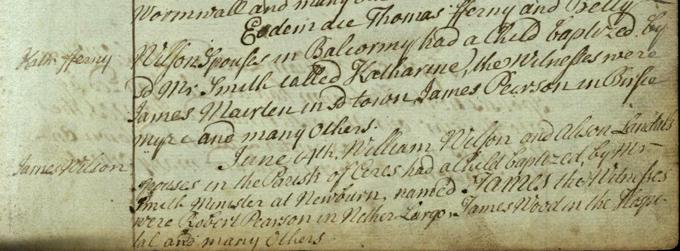
Crown copyright, NRS, OPR of Births for Largo, 1743, 443/120 page 362.
The OPR of Largo also records the births and baptisms of six siblings born between 1736 and 1748. Another brother was born in the parish of Ceres, Fife, in 1752.
Wilson was an intelligent and ambitious young man. The son of a farmer, he had humbler beginnings than most of his revolutionary contemporaries who campaigned for the independence of the American colonies. He attended Cupar Grammar School, where he worked hard to earn a scholarship to St Andrews University. There, at the age of 15, he attended the United College of St Salvator and St Leonard where he studied as an arts student between 1757 and 1761. He then began to study for a degree in divinity between 1761 and 1762 at St Marys, the theological college of St Andrews University.
However, dreams of a life in the ministry had to be put to one side, when Wilson’s father William died in 1762. He returned home to financially support his family, tutoring for a period before briefly moving to Edinburgh in 1765. Although he did not graduate with a degree from university, his time there exposed him to the Scottish Enlightenment – a movement focusing on scientific, philosophical, and economic thought. Wilson was keen to rise in status and build his own financial security. His life in Scotland offered few opportunities to achieve this. In search for new beginnings he emigrated to America in 1765.
Wilson arrived in New York in the midst of the controversy over the Stamp Act. This was the first direct tax imposed on the American colonies by Britain, requiring colonists to pay a tax on nearly all printed materials, including legal documents and newspapers. Although this act was ultimately repealed, it caused unrest. Wilson’s experience of this helped to shape his perception of British rule and radicalise him on the side of the colonists.
He carried with him letters of introduction which allowed him to teach at the College of Philadelphia. There he was awarded an honorary Master of Arts degree in 1766. He then spent a year studying law with John Dickinson (a politician who would later oppose the Declaration of Independence). During his career he practised law in Reading (Pennsylvania, where he began a private law practise in 1768), Carlisle (Pennsylvania) and Annapolis (Maryland).
Whilst Wilson did not write any of the Declaration of Independence, he did author an essay titled ‘Considerations on the Nature and Extent of the Legislative Authority of the British Parliament’. First drafted in 1768, it argued that the British Parliament had no authority or binding legal relationship over the colonies; a fact which he was amazed to discover. This was groundbreaking, and, as a man at the beginning of a successful career, he decided not to publish his work. Instead, he kept the draft private until 1774 when he published it anonymously. Readers immediately credited the work to Benjamin Franklin, who unveiled the name of the real author; Wilson quickly became a recognisable name. His work contributed to the legal theory behind the powerful statement ‘no taxation without representation’, which argued that the colonies had no voice in the British Parliament, and any taxes imposed on them were illegal and an infringement of their liberties.
Wilson was a powerful advocate for independence. In 1775 his political career soared. He was elected to Pennsylvania’s provincial convention (or congress) which sought to initiate self-rule and bypass British authority. In November, he was re-elected to the second continental congress and worked to convince his constituents that independence was the future. He held off voting until he had local support, which came in 1776, leading him to sign the Declaration of Independence.
Wilson’s talents had been recognised, and he was trusted in developing juridical elements of the Constitution (the supreme law of the United States of America). He wrote the famous opening words to the preamble of the Constitution: ‘We the People’, emphasising that individuals were to be prioritised over the state itself. This followed his belief in the power of regular people, whom he saw as ‘the legitimate source of all authority.’ [Source]
He signed the final version of the Constitution on September 17, 1787; one of only six individuals to sign both the Declaration of Independence and the Constitution.
Although Wilson was a supporter of individual liberties and freedoms, he did not extend this to all people. In the case of slavery, for example, Wilson was less outspoken than some of his peers. Although he stated that he was opposed to it, he kept an enslaved person, a man called Thomas Pursel, for many years, only freeing him in 1794.
In 1789, President George Washington appointed Wilson to serve as an Associate Justice on the United States Supreme Court (although he would be overlooked as the first chief justice on more than one occasion). During his time there he also taught law at the College of Philadelphia (now the University of Pennsylvania) where he delivered a series of lectures. His first, on 15th December 1790, was attended by President Washington, Vice President John Adams, Secretary of State Thomas Jefferson and numerous members of Congress.
Fellow signer of the Declaration of Independence, Benjamin Rush, described Wilson as:
‘An eminent lawyer, an enlightened statesman a profound and accurate scholar. Mr Wilson’s personal appearance made his eloquence even more impressive. He stood six feet tall with a large frame and erect bearing, and his fiery energy went into his declamations. Though his voice was not melodious, it was powerful, and his blue eyes gleamed through heavy spectacles rimmed in metal.’ [Source]
Wilson married twice. His first wife was Rachel Bird of Reading, the youngest daughter of ironmaster William Bird, who had founded the Birdsboro Ironworks in Pennsylvania. They married on 5th November 1771 in St Gabriel’s Episcopal Church, Amity Township, Pennsylvania. They had six children between 1772 and 1785 before Rachel's death on 14th April 1786 in Philadelphia. Seven years later, in 1793, he married 19-year-old Hannah Gray, the daughter of Mr Ellis Gray, a Bostonian merchant. Their 30-year age gap caused a scandal in society. Together they had a son, Henry, who died in infancy.
Towards the end of his life, Wilson made a series of ill-judged investments in land in New York and Pennsylvania. His desire to build a fortune had led him to buy undeveloped and vacant land to sell on at a profit when the price had appreciated. This did not come to pass, and he fell badly into debt. To avoid imprisonment by his creditors, he left Philadelphia for Northern Carolina, where he toured judicial circuits with Judge Iredell of the Supreme Court. Wilson was caught in the spring of 1797 at Burlington, New Jersey, by one of his creditors. He was imprisoned and only freed when his son Bird managed to raise sufficient funds to pay the debtor. He was arrested for further debts the following spring, and, after his subsequent release, spent the remaining period of his life as a fugitive in declining mental and physical health.
He returned to Edenton, North Carolina, where he contracted malarial fever. He suffered a stroke on 18th August 1798 and died three days later, aged 56 years old, the first Supreme Court Justice to pass away in office.
Although Wilson was still a Supreme Court justice and a law professor at the time of his death, his financial distress had greatly damaged his reputation. His death was not widely announced and he was not remembered as an important and influential character in the development of the early years of the United States of America. Originally buried in North Carolina, his remains were removed to Philadelphia in 1906. His casket lay in state in Independence Hall before he was reburied in Christ Church Churchyard where six other signers of the Declaration are buried, including Benjamin Franklin. On his gravestone reads a passage written by Wilson himself:
‘That the Supreme Power, therefore,
should be rested in the People is, in
my judgment, the great panacea of human politics.’
Andrew Bennett, in his work ‘James Wilson of St. Andrews: An American Statesman, 1742-1798’ reflected that:
‘Compared to his contemporaries, Madison, Hamilton, Jefferson, Patrick Henry, Lee, Adams he never laid hold of the popular imagination. But in intellectual force and independence he may well be ranked with Washington and Franklin, and in foresight he was probably superior to them all…Few of the citizens of St Andrews, whether they stayed at home or adventured far into the world, who have counted for more in the affairs of the world than her half-forgotten son, James Wilson.’ [St Andrews Citizen, Saturday 3rd September 1927].
Further reading and sources
Witherspoon, John (1723–1794), Church of Scotland minister and college head in America, Oxford Dictionary of National Biography (Subscription or UK public library membership required).
John Witherspoon (1723–1794), President (1768–94), Princeton University Art Museum
John Witherspoon: From Daring Escape to Founding Father
John Witherspoon, His Scottish Ministry by William Oliver Brackett, University of Edinburgh, 1935
Jesse Wegman, This Founding Father Died in Disgrace. But He Can't Be Forgotten.
Dickinson College, Archives & Special Collections, James Wilson (1742-1798)
Mount Vernon, Digital Encyclopedia, James Wilson
National Constitution Center, James Wilson
Wilson, James (1742-1798) by Stephen Conrad, Oxford Dictionary of National Biography (Subscription or UK public library membership required).
Women History Blog, History of American Women, Rachel Wilson