Introduction
“Stolperstein”, which in German means “stumbling stone” or metaphorically “stumbling block”, is a small concrete block bearing a brass plaque embedded in pavements to commemorate the last place people freely resided before they fell victim to Nazi persecution. The project was initiated by the German artist Gunter Demnig (b. 1947) in Germany in 1992. To date, 116,000 stones have been laid across Europe. It is the largest decentralised Holocaust memorial in the world.
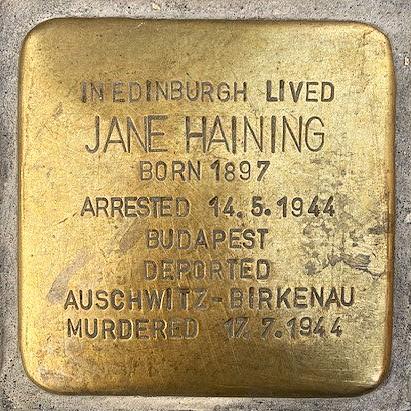
On 24th November 2025, Scotland’s first Stolperstein was unveiled in Edinburgh on the pavement outside the former St Stephen’s church building in Stockbridge, Edinburgh, in memory of Jane Haining. The event was attended by members of Haining’s family, Edinburgh Central SNP MSP Angus Robertson, leaders from the Christian and Jewish faiths and representatives of the Hungarian government.
Crown copyright, National Records of Scotland (NRS)
Transcription of Jane Haining’s Stolperstein:
In Edinburgh lived
Jane Haining
Born 1897
Arrested 14.5.1944
Budapest
Deported
Auschwitz-Birkenau
Murdered 17.7.1944
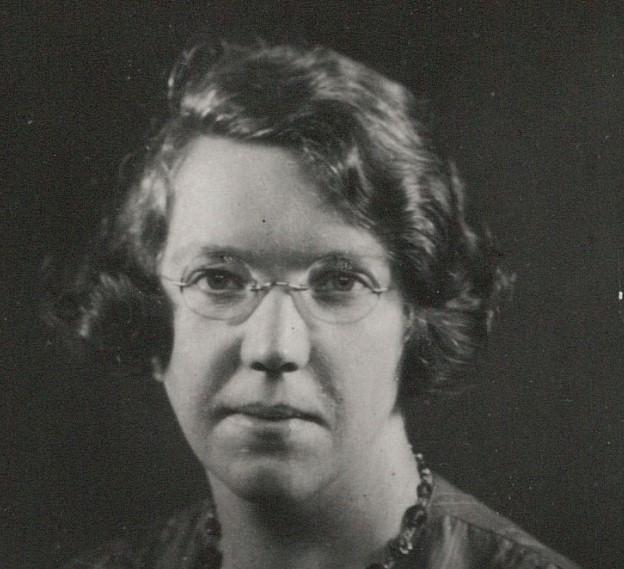
In this article, we look at Haining’s life in order to honour her memory and commemorate Holocaust Memorial Day on 27th January which marks the anniversary of the liberation of Auschwitz-Birkenau, the largest Nazi death camp.
Public domain, via Wikimedia Commons
Birth in 1897
Jane Mathison Haining was born at 7:15pm on 6th June 1897 at Lochenhead Farm, Dunscore, Dumfriesshire. She was the fifth child of the six children of Thomas John Haining, a farmer, (1866-1922), and his first wife, Jane Mathison (1866-1902), a farmer’s daughter. They had married seven years previously on 14th March 1890 in Terregles, Kirkcudbright. Jane was named after her mother and given her mother's maiden name.

Crown copyright, NRS, 1897/822/14
Early life and education
Haining’s early years were spent at the family farm, Lochenhead. In 1901, she was enumerated there, aged three, with her parents, John and Jane, aged 34 and 35, and two elder sisters, Alison and Margaret, aged ten and six. The census return for the district of Dunscore is over two pages and shows that the household also included a general servant, a young woman called Rankin C. Park, aged 17.


Crown copyright, NRS, 1901/822/4, pages 2-3
In August 1902, Jane Haining’s mother died due to collapse caused by pernicious anaemia of 13 months duration, aged 36, a fortnight after giving birth to her sister Helen. Haining was only five years old.
Haining had a devout upbringing and was a member of the evangelical Craig Church in Dunscore, part of the United Free Church of Scotland. She was educated at the local village school and in 1909 won a scholarship to Dumfries Academy, where she boarded at the Moat Hostel for Girls.
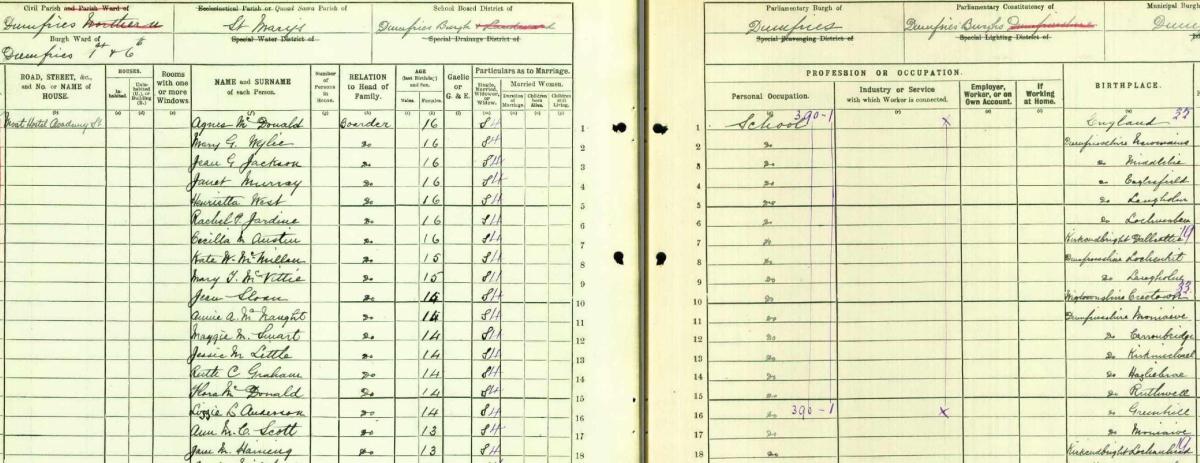
In the 1911 census, she was enumerated at the Moat Hostel in Academy Street, Dumfries, aged 13. The census return provides the names of some of her fellow pupils and the superintendent of the Burgh School Board.
Crown copyright, NRS, 1911/821/1, page 2

Crown copyright, NRS, 1911/821/1, page 2
The census return for the family farm in Dunscore records her father, a widower, and her sisters Alison and Margaret. Her younger sister Helen had died aged one from measles in 1904.
Jane won numerous prizes at school, showing an aptitude for languages, and graduated as “modern dux”.
![Jane Haining [in the school hockey team] at Dumfries Academy, front row, second right. c 1909-1916.](/sites/default/files/styles/maximum_size/public/2026-01/1024px-Jane_Haining%2C_Dumfries_Academy%2C_1909%E2%80%931916%20.jpg?itok=NX5ma_Me)
Public domain, via Wikimedia Commons
After leaving school, Haining continued her training in Glasgow at the Athenaeum Commercial College. She then worked for ten years for J. and P. Coats Ltd, a thread manufacturer, in Paisley from 1917 to 1927.
In the 1921 census, she was enumerated at 50 Forth Street, Pollokshields, aged 24. Her occupation at J. and P. Coats Ltd is recorded as an invoice clerkess.

Crown copyright, NRS, 1921/644/18 18, page 24
Missionary work
Haining’s life outside work revolved around her church. She attended Queen’s Park West United Free Church, near to her home in Pollokshields. There she found her true vocation and was inspired to become a missionary. She left J. and P. Coats Ltd, and studied for a year’s diploma course in domestic science and housekeeping at the Glasgow College of Domestic Science. She undertook temporary posts in Glasgow and Manchester and, in 1932, applied to be the matron in the Girls' Home of the Church of Scotland’s Jewish Mission School in Budapest.
Before taking up the appointment, she attended St Colm’s, a women’s missionary training college in Edinburgh. Her dedication service took place in St. Stephen’s Church in Edinburgh, on 19th June 1932, and she left for Budapest the following day.
Haining settled quickly in Hungary. The Scottish school had around 400 day pupils, aged from six to 16, with fifty boarders in her care. The majority of the pupils were Jewish, though Christianity was taught to all. Haining became fluent in Hungarian and earned the trust of the girls, many of whom were orphans or had been separated from their parents.
During the late 1930s, large numbers of refugees were propelled to Hungary due to the Nazi expansion into Austria and Czechoslovakia. This led to more Jewish children seeking sanctuary at the mission home.
The Second World War broke out on 3rd September 1939. At the time, Haining was on holiday in Cornwall with her friend Margit Prém, headmistress of the higher school. They both returned to Budapest immediately.
Haining refused repeated advice from the Church of Scotland’s mission committee in Edinburgh to return home, putting the welfare of the children in her care above her own needs. The situation in Hungary worsened and contact with Edinburgh became increasingly difficult. Haining arranged for the Hungarian Reformed Church to keep the school running. By early 1944, she was in a perilous situation.
Arrest and death
On 19th March 1944, the Nazis occupied Hungary. Anti-Jewish measures intensified, including the requirement for Jews over the age of six to wear the Yellow Star of David on their clothing.
A month later, Haining was arrested on 25th April by the Gestapo on the following charges:
1. That she had worked amongst the Jews.
2. That she had wept when seeing the Yellow Star of David on her Jewish boarders.
3. That she had dismissed her housekeeper, who was an Aryan.
4. That she had listened to the BBC news broadcasts.
5. That she had many British visitors.
6. That she was active in politics.
7. That she visited British Prisoners of War.
8. That she had sent parcels to the British prisoners.
She admitted all the charges against her, except the allegation of political activity. She was initially imprisoned by the Gestapo in Budapest before removal to a holding camp. In May 1944, she was transported along with Hungarian Jews to the German extermination camp, Auschwitz-Birkenau, in Nazi-occupied Poland.
Haining’s last known communication from Auschwitz was a letter to Margit Prém dated 15th July 1944. She asked after the school and its children and for fresh and dry food supplies to be sent to Auschwitz. Two days later she was dead.
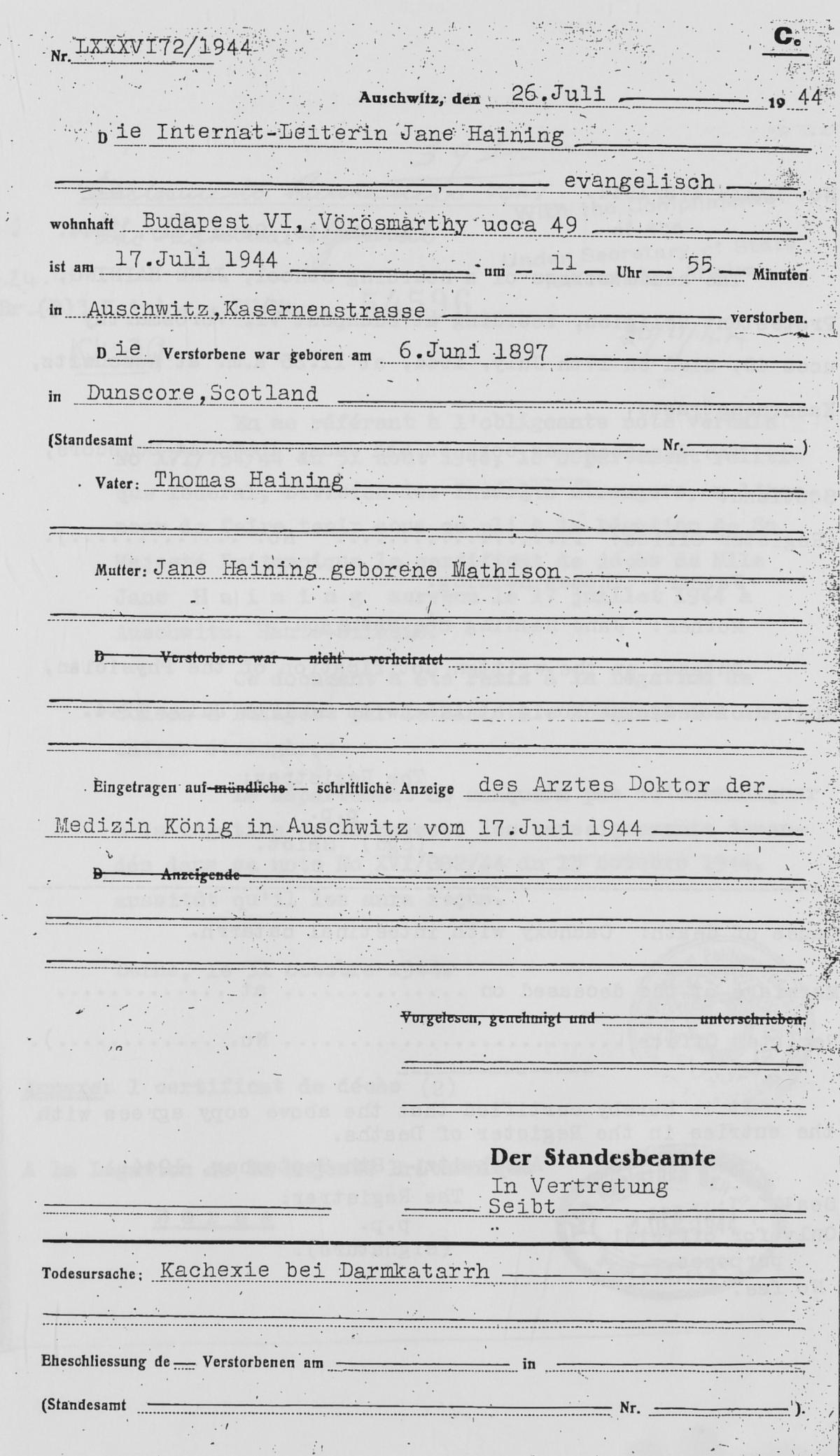
The exact circumstances surrounding her death are unknown. According to the death certificate which arrived in Edinburgh a month after her death, she died in hospital on 17th July of cachexia (a wasting syndrome), following intestinal catarrh. She was 47 years old. However, recent research suggests that she died in the gas chambers at Auschwitz. (Source: Miller, Mary, 'Jane Haining A Life of Love and Courage', (Birlinn, 2022), page 168.
NRS, Death Intimations, Birth, Death and Marriage, Foreign Countries, Intimations, Volume 158 Documentation 392
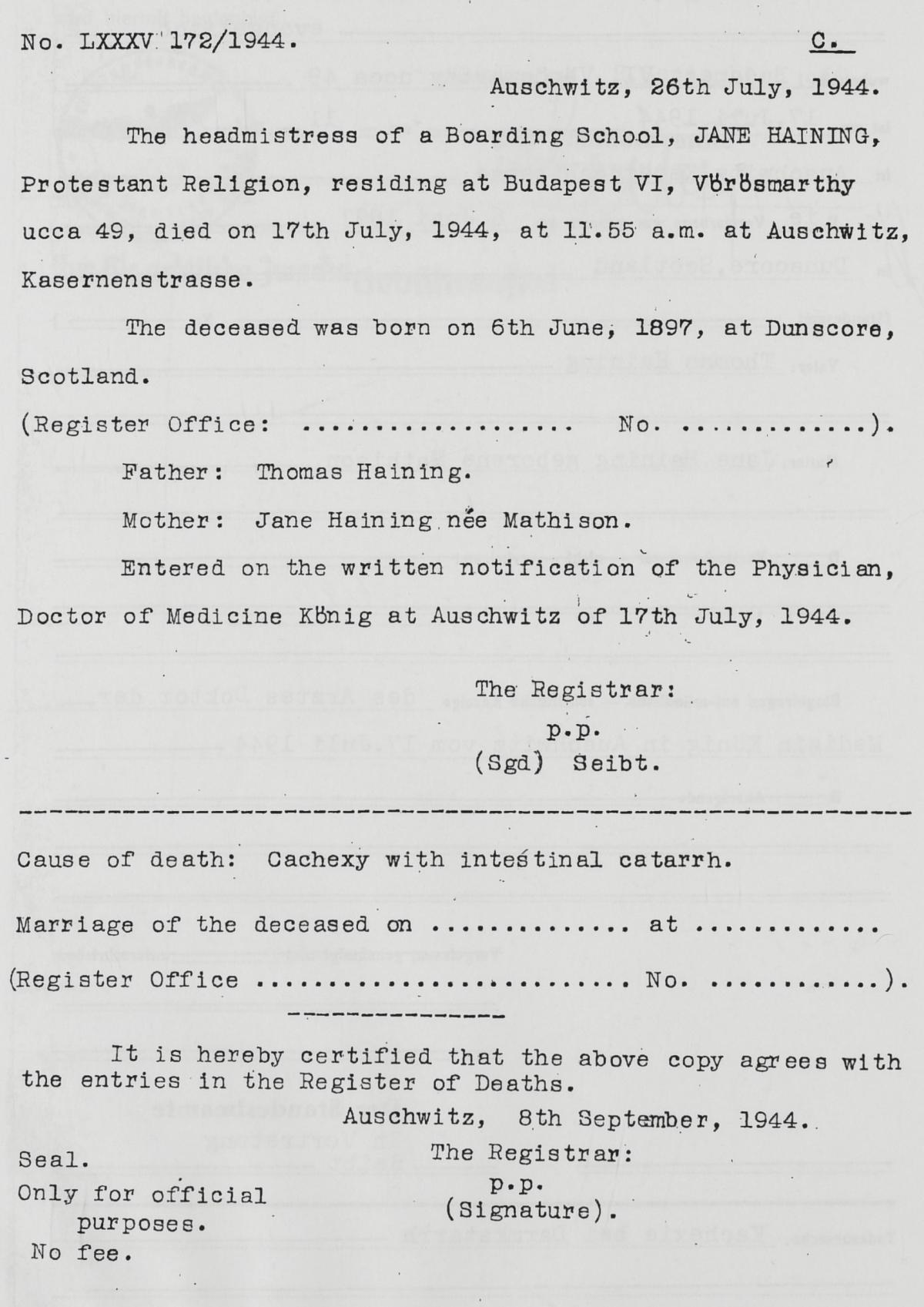
NRS, Death Intimations, Birth, Death and Marriage, Foreign Countries, Intimations, Volume 158 Documentation 392
In the absence of a will at the time of her death, Haining’s estate was recorded as intestate.
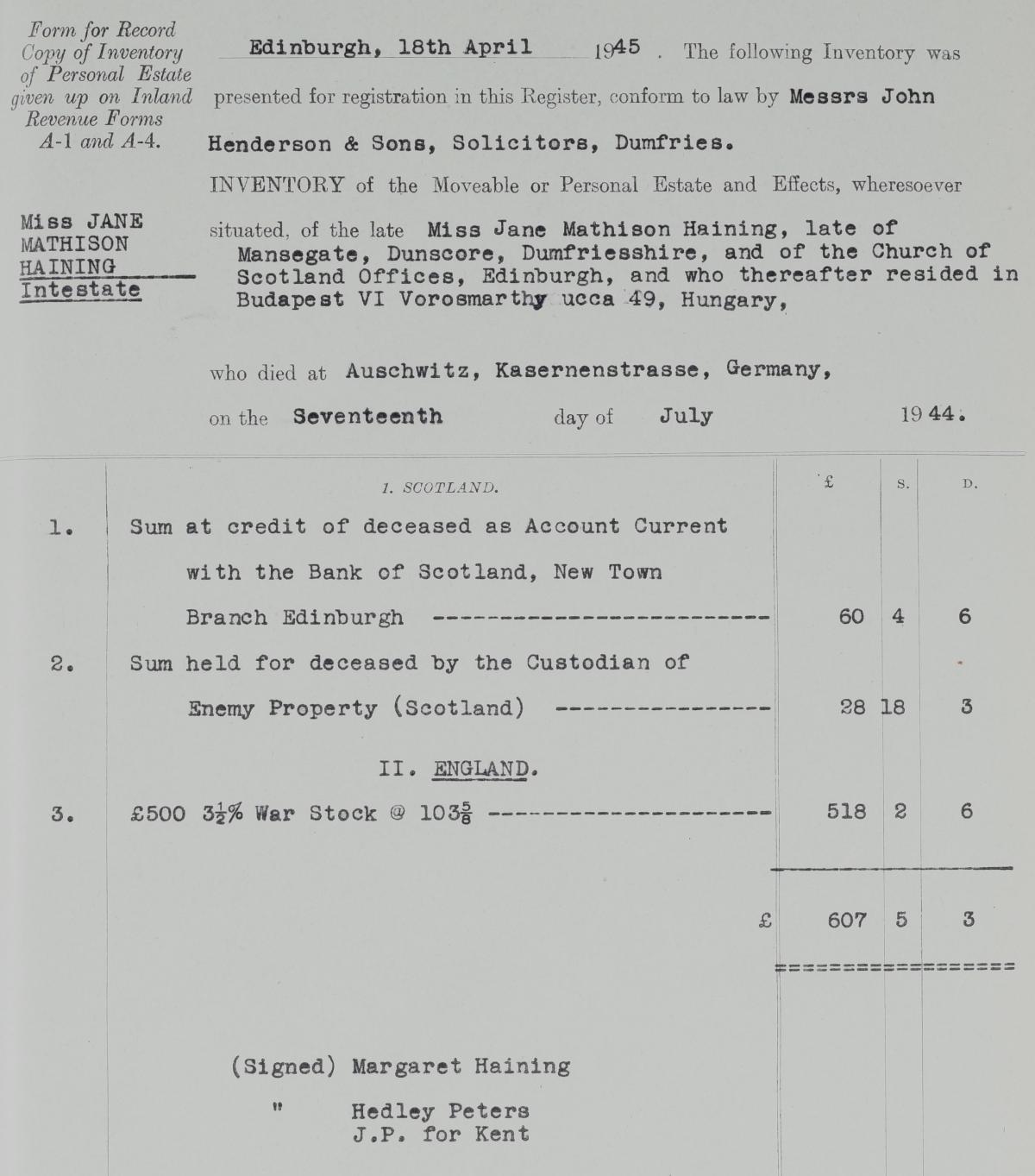
Crown copyright, NRS, SC70/1/1124, page 645

Crown copyright, NRS, Scottish Calendar of Confirmations Index, CAL/1945/A/396
The inventory records her last place of residence in Budapest and her death at Auschwitz. The inventory and confirmation record that her estate was valued at £607 5s 3d and her next of kin was her older sister Margaret. The Bank of England's inflation calculator calculates that Haining’s estate would be worth around £22,851.97 today.
Legacy
Haining’s courage and devotion to the children in her care is remembered today in a variety of ways and locations. These include: an exhibition at her local church in Dunscore; a memorial created by former pupils at Dumfries Academy; two stained-glass windows at Queen’s Park Govanhill Church, which she attended before she went to Budapest; and a Stolperstein laid in 2024 at the entrance of St Columba's Church of Scotland in Budapest, directly next door to the former Scottish Mission School.
She was enrolled as 'The Righteous Among the Nations' at Yad Vashem Holocaust Remembrance Centre in Jerusalem, Israel. She is the only Scot to be given this honour. She was also posthumously awarded a Heroine of the Holocaust medal by the UK Government.
Haining’s most recent commemoration is the first Stolperstein to be installed in Scotland. It remembers her as a victim of the Nazis, but also acts as a warning to current and future generations to learn the lessons of history of extremism and persecution.
Further reading and sources
Manuscript sources
The National Library of Scotland (NLS) hold Jane Haining’s last letter, a photograph of her and other papers relating to Budapest as part of the Church of Scotland’s World Mission Board archive: Acc.7548/G/46a.
Haining’s will and photographs of the pupils from the mission school are held by the Church of Scotland.
Please note that the manuscript sources were not consulted for the purpose of this article. Enquiries regarding access should be directed to the NLS at: manuscripts@nls.uk
Secondary sources
The Church of Scotland, ‘Brass memorial for Scottish Holocaust victim unveiled in Edinburgh’, 24th November 2025.
Ewan, Elizabeth; Innes, Sue; Reynolds, Sian (editors), ‘The biographical dictionary of Scottish women from the earliest times to 2004’, (Edinburgh University Press, 2006).
Life and Work: the Magazine of the Church of Scotland, ‘Rediscovered Documents Shed Fresh Light on Jane Haining’, 14th September 2016.
Metcalfe, Alison, National Library of Scotland, ‘Jane Haining’s Letter from Auschwitz’, Scottish Review of Books, 12th April 2019.
Miller, Mary, 'Jane Haining A Life of Love and Courage,' (Birlinn, 2022).
Staveley-Wadham, Rose, ‘Courage and Devotion to Duty’ – Remembering Jane Haining, The British Newspaper Archive Blog, 18 March 2021.
Walker, Charles (editor), ‘A Legacy of Scots: Scottish achievers’, (Mainstream Publishing, Edinburgh, 1988).
Wright, D. (2004, September 23). Haining, Jane Mathison (1897–1944), Christian missionary and martyr. Oxford Dictionary of National Biography. Retrieved 6 Jan. 2026, from https://www.oxforddnb.com/view/10.1093/ref:odnb/9780198614128.001.0001/odnb-9780198614128-e-48816. (Subscription or UK public library membership required).