Over 4,500 entries from Inveraray prison registers, covering the years 1828-1841 and 1848-1887, can now be searched and viewed online. Entries capture various details about prisoners. This information can include names, age, height, weight, crime, sentence, religion, health and the prisoner’s ability to read and write. For more information about searching the prison registers, please see our guide.
In the 1800s, the prison held men, women and children (some as young as seven years old) for various crimes ranging from the theft of sheep or turnips, to night poaching and murder.
Today, Inveraray Prison no longer houses convicted members of the public, but is run as a historical museum for people to explore. Visitors can experience what life was like for 19th century prisoners through exhibitions, costumed characters and educational audio guides.
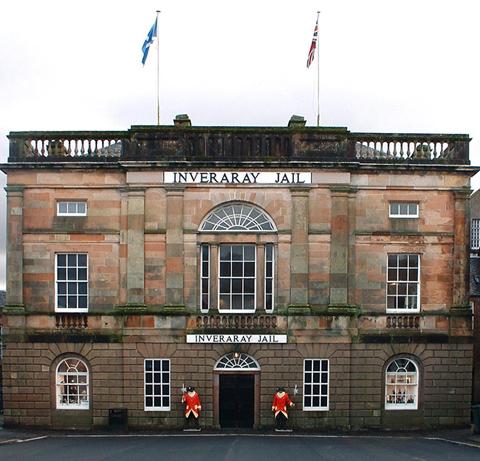
Image courtesy of Inveraray Jail
This article will explore the history of Inveraray Prison and share some stories of the people imprisoned behind its walls.
The Prison
The surviving Courthouse and prison building was completed around 1820. Prior to its construction, the courts met in the Courthouse on Front Street. Prisoners were held on the ground floor beneath the court in inadequate conditions; a grated piazza in front of their cells left them visible to passers-by on the street and also led to multiple escapes.
In 1807 architect Robert Reid submitted plans for an improved prison with separate wings for male and female prisoners and debtors, but a lack of funds prevented this from going ahead.
Five years later, in 1813, a complaint was issued by the High Court of Justiciary to the Sheriff of Argyllshire about this situation.
The Inveraray Gaol and Courthouse Act was passed in 1814. The Act stated that ‘the present Gaol in the Burgh of Inveraray is insecure, confined, damp and ill adapted for the Purposes thereof; and it has become necessary to build a new Gaol in a dry and healthy Situation, of sufficient Dimensions to receive all Criminals committed for Trial before the Circuit Court of Justiciary.’ It also stipulated that a courthouse was to be built beside the gaol, containing rooms for the Circuit Court, the Sheriff and Burgh Court and meeting rooms. Reid’s original plans were simplified by architect James Gillespie. A new courthouse was constructed and prison accommodation consisting of one eight-cell block.
Note that Inveraray can also be spelt ‘Inverary’ in historical records. This is due to old variations in spelling and the anglicisation of the Scottish Gaelic ‘Inbhir Aora’ (mouth of the [River] Aray). The spelling Inveraray is the modern, official and most widely-accepted spelling.
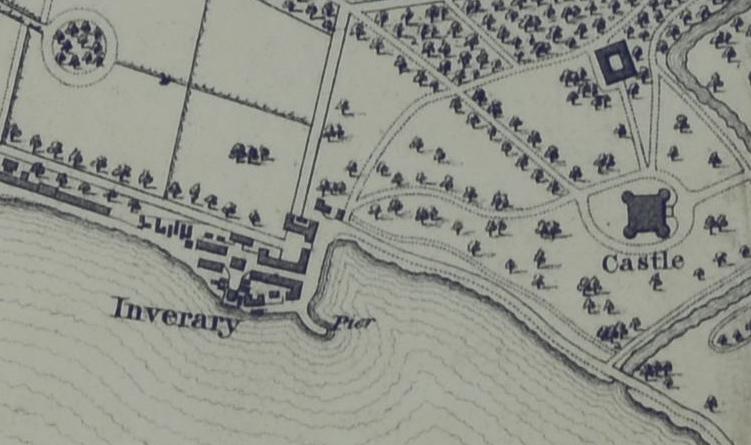
NRS, RHP13044/24
The Prisons (Scotland) Act 1839 radically overhauled the Scottish prison system and bestowed general superintendence of all Scottish prisons into the hands of the General Board of Directors of Prisons in Scotland. Although formal training procedures were not in place at this time, strict operational rules for prison officers (keepers) and matrons were established by this Act, which mandated daily inspections of the prison and prisoners by keepers, strict separation of male and female prisoners and prohibited using prisoners for staff duties. It laid the foundation for professionalising Scottish prison staff.
Further areas for the housing of prisoners were designed by architect Thomas Brown of Edinburgh and opened at the end of 1848. At this time, the prison consisted of 12 individual cells, with a water closet on each floor and accommodation for warders. Gas heating and lighting were installed; an improvement from the prison of the 1820s which was dark and damp.
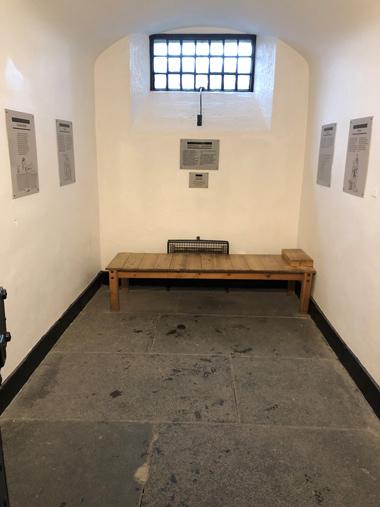
Image courtesy of Inveraray Jail
Prisoners were kept occupied picking oakum. This was the fibre obtained from short lengths of rope that had been teased apart. Once picked, it was used to stuff mattresses or seal the seams of wooden ships. Men also made herring nets which were sold to local fishermen whilst some female prisoners spent time knitting or sewing. Inmates worked for up to 10 hours a day. Some male prisoners were given hard labour which included the repetitive activity of turning a crank machine, in some cases up to nearly 14,500 times per day. Limited exercise was provided in the Airing Yards.
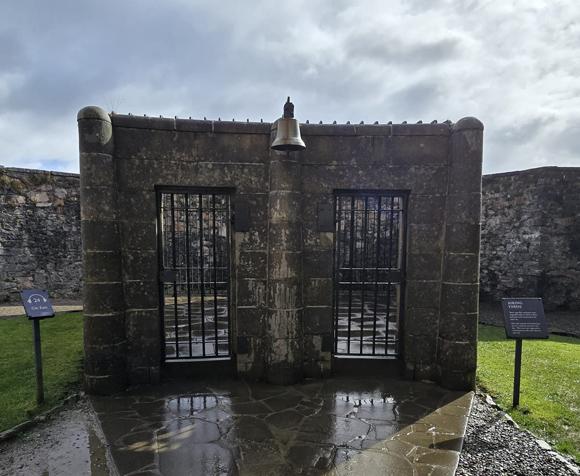
Image courtesy of Inveraray Jail
The Prisons (Scotland) Act 1877 modernised the Scottish penal system by centralising control under a new Prison Commission for Scotland and transferring funding responsibilities from local authorities to the central government. Smaller prisons, such as Inveraray, fell out of favour due to their increased running costs and inefficiencies compared to larger prisons such as Barlinnie in Glasgow, which was completed in 1882.
The prison closed on 30th August 1889. It functioned as a local police centre, with its courtroom remaining in use for trials until 1954. The building then served as an administrative centre. It opened as a museum in 1989, 100 years after it closed as a prison.
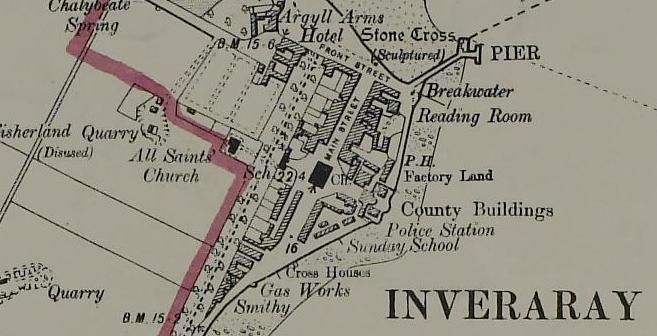
NRS, RHP76216
The Prisoners
Who was imprisoned in Inveraray? Records now available on Scotland’s People show that prisoners ranged from children as young as seven years old (James McCulloch, admitted in October 1868 and sentenced to five years in an industrial school for the crime of theft) to adults aged 82 years old (Ann Kerr, admitted in August 1841 and sentenced to eight days' imprisonment for vagrancy). Most of the prisoners were Scottish, but ranged from as far afield as Syria, Australia and India.
Below are the stories of a few of these prisoners.
Archibald Graham (c.1791-1882) and Martha Graham (c.1825-1895)
Mary McGlashan (1837-1889)
‘The Escapees’ - William Dickson, James Duncan and John Campbell
‘The Highland Hotel Robbers’ – James Edward Lyon, Eliza Thorpe and Joseph Dowling
Archibald Graham (c.1800-1892) and Martha Graham (c.1825-1895). Father and daughter accused of stealing a sheep’s carcass.
Archibald and Martha Graham lived in Conisby, in the parish of Kilchoman on the island of Islay. On 9th May 1866 they were admitted to Inveraray Prison.
Archibald, who was 75 years old, was described as being 5 feet 1 inch tall, bald, and a pauper in ‘tolerable’ health. He had worked as an agricultural labourer for most of his life. In this area of Scotland, farms were generally let to tenants who cultivated land for growing annual arable crops on the runrig system. This system divided farmland into narrow, alternating strips ("rigs" or ridges) worked by different tenants, who were often reallocated on an annual basis. Animals were grazed locally on common pasture land. Labourers cultivated and raised barley, oats, potatoes, hay, turnips, peas, cows, sheep and fish.
The 1845 Statistical Account of Scotland tells us that ‘the sheep kept, with the exception of one or two lots of the black-faced breed, are of a very ordinary kind – being chiefly in the hands of small tenants, who keep them as an overstock, and they are so badly managed as not to prove a source of profit.’ (Source: Statistical Accounts of Scotland)
It was the dead body of one of these sheep that Archibald and his daughter Martha were imprisoned for two months for stealing.


Crown copyright, NRS, HH21/35/4 page 49
Martha was aged 41, in employment as a house keeper and in good health. The prison register also recorded that she had a ‘google eye’. Today, this may be termed as exophthalmos, which describes the abnormal protrusion or displacement of an eyeball (or eyeballs) from the socket.
Martha was born around 1820 on Islay. Her parents, Martha and Archibald had married in November 1817. According to The Old Statistical Accounts of Scotland, parochial registers of births were only maintained in the area from 1822 and no record of Martha’s birth has been traced on Scotland’s People.
By the 1841 census, Martha senior had died, and Archibald had remarried to Mary Campbell. At this time, around 4,500 people lived in the area, with Gaelic being universally spoken and English becoming more common.
Life on the island was challenging. 20 years before the Grahams were imprisoned, the New Statistical Account recorded that ‘In many instances, the cattle occupy the same apartment with the family… their ordinary food is potatoes, with milk and fish. During a great part of the year, very little oatmeal is consumed’ (p652). The author, The Reverend Alexander Cameron, late minister of the parish of Kilchoman, captured a rather negative view of the population: ‘As a people, they are shrewd, fond of gossip and story-telling; there is amongst them a strong bias to cunning, and a want of truthfulness. Of the grown-up population the majority are unable to read; - their minds are, therefore, comparatively uninformed, - and it cannot be said that they are either a moral, or a religious people; and from the influence which their confirmed habits are producing on the rising generation, who are receiving a moral and religious education, a very immediate and decided change is scarcely to be expected.’
Further information on the background to the theft is yet to be uncovered to explain their motives. Perhaps the Grahams needed food, or sought to sell the wool. In 1871, the census records Archibald, now 80, as a labourer. His daughter remained at home, unmarried, but with no recorded employment.
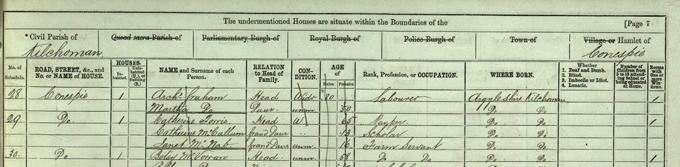
Crown copyright, NRS, 540/7/7
Ten years later Archibald is enumerated as a ‘former agricultural labourer’ and Martha, 60, working as a ‘general servant, domestic’.
Archibald died on 30th April 1892 in Conisby from ‘old age.’ His step-son, Alexander Campbell, witnessed his death entry. Martha died three years later in Consiby, on 20th March 1895, aged 75. She was recorded as a pauper, who died from ‘influenza, congestion of lungs 14 days’, by John Gillespie, Inspector of the poor at Port Charlotte, Islay.
Mary McGlashan (1837-1889). Child murder – concealment of pregnancy.
Mary McGlashan, a 26-year-old woman living in the town of Hafton, in the parish of Strachur and Strathlachlan, in Argyllshire, was found guilty of ‘wickedly and feloniously depriv[ing] [her newborn child] by rolling or wrapping it up in a bed-gown and shift, and putting it into a band-box, and then shutting up the said band-box containing the child in a chest or trunk… and did fail or neglect to tie the umbilical cord attached to the said child, whereby the said child did lose much blood; by all which means… the said child was bereaved of life, and was thus murdered.’ (NRS, JC26/1864/127)
She was admitted to Inveraray prison on 1st January 1864. Although the baby’s body wasn’t found until the following day, she was taken into prison due to her perceived fragile mental state, and high suspicion over her concealed pregnancy. Mary’s prison entry records her as a domestic servant, 5 foot 2 in height, with a fresh complexion, brown hair and grey eyes. Her health was ‘tolerable.’ She served a six month sentence before being released on 15th October 1864.

Crown copyright, NRS, HH21/35/4 page 43
Mary had given birth to a baby boy on the 18th of December 1863. In her statement to police, she claimed that she hadn’t known she was pregnant, that her baby was born dead and she had put his body into Loch Fyne.
Subsequent interviews with members of the local community confirmed that Mary’s condition had been obvious. Archibald McKeller, a local quarrier, said that:
‘for the last two months I was positive she was pregnant. About a fortnight ago and to the best of my knowledge on Saturday 19 Dec[ember] 1863 I met accused on the public Road and I saw there was a change upon her. I was sure she had given birth to a child… I met her between 9 & 10 o’clock in the morning…She was a little startled like when she saw me… She looked pale & ill. She had a gown over her arm. I saw the size of my hand marked as with blood on the gown. In talking I went round her, and saw a great deal more blood on the gown. I made no allusion to it, to her, or any one else, but on going home I told my wife I had seen her … Accused at the time was coming from Pole Schoolhouse and going home… She seemed so weak that I do not think she could have walked much further. Accused never told me she was pregnant.’ (NRS, AD14/64/124)
Mary had been staying with 58-year-old Christina Macfarlane. Christina lived in the schoolhouse with her sisters, Eliza and Helen who were taking a short holiday in Glasgow. Christina invited Mary to stay whilst they were away as Mary’s home was cramped, damp and overcrowded. Archibald Mackay, criminal officer, described the family home in his evidence:
‘It…does not extend to above 20 feet by 14 feet. It is made of posts and slabs with a turf roof. A press bed is placed in the middle so as to divide the place into two apartments. That bed seemed to be used by Mr McGlashan & his wife & little girl [Sarah, aged 10]. In the other end there was a bed used by three sons [Peter, 21, Neil, 17, Dugald, 15], and a small place at the foot of it was used as a bed for accused.’ (NRS, AD14/64/124)
Christina told the jury that Mary came to stay every night, arriving at bedtime and leaving first thing in the morning, and consistently wore a plaid shawl around her body which concealed any signs of pregnancy. Christina was storing some chests containing clothing belonging to the McGlashan family to prevent them getting damp. It was in one of these trunks that the baby was found. Christina had heard no noise of a baby being born.
In the McGlashan family home, underneath her parents' bed, was found Mary’s blood stained chemise. It was believed that Mary had given birth either in Christina’s home, or in another nearby place, before hiding the baby in the schoolhouse. She then returned to her home where she hid her stained clothing.
On 3rd January 1864 a post mortem was carried out by Drs Macdonald and Paul on the body of Mary’s child: ‘the said male child was born viable… that it had breathed and…looking at the absence of all external marks of violence and any internal malformation, that it died ether through exposure or from haemorrhage owing to the umbilical cord not having been secured.’ (NRS, AD14/64/124)
A physical examination of Mary confirmed she had recently given birth.
Surviving evidence does not confidently name the father of the baby, however Jane McArthur, a local 24-year-old resident in the town claimed that ‘the paternity was prescribed to one McGibbon, in whose service she had been’. He had since left the area and no other mention was made of the father in the surviving court papers. Focus was given to Mary’s actions and the resulting death of the child.
Mary served a six month sentence in Inveraray Prison and was released on 15th October 1864.
Almost a decade later, on 12th December 1873, Mary married Donald Sinclair, a 46-year-old ploughman at St Catherine’s in the parish of Strachur. They had three children together: Bella, born 1877, Peter born 1879 and Sarah born 1881.
Mary died aged 51 in the Western Infirmary, Glasgow, on 15th December 1889. Her cause of death was peritonitis from the perforation of her bowel and cirrhosis of the stomach (a build-up of fluid in the stomach area).
The Escapees - William Dickson, James Duncan, and John Campbell
A copy of a letter to the Prison Board in the Governor’s Journal for Inveraray Prison on 12th August 1874 reads:
‘Sir I am sorry to have to inform you that three of my Prisoners made their escape from the Prison…last night or early this morning. Immediately on discovering it I gave information to the Procurator Fiscal and Constables of the district and… no trace has as yet been got of their whereabouts. I am unable to say how they made their escape. This morning at 5.40 I went to the Prison… the Warder… told me that three of the prisoners viz William Dickson, John Campbell & John Duncan, from Glasgow, for Housebreaking near Dunoon were all escaped [and] on going to their cells doors… he found them all locked but no one in them. I then searched the Prison and on getting …[the] doors open I found the prison clothing they were wearing all lying and their over clothes away. In the small stone room where access can be had to the roof I found the padlock removed and the window open with a rope hanging down to the ground outside the prison. The warder assures me he found all his keys on getting up this morning exactly where he left them last night & that he heard no noise during the night’. (NRS, HH12/57/1)
The warder was later found to be innocent of any wrongdoing.
Campbell, a shoemaker aged 27, Dickson, a mason aged 28, and Duncan an engraver aged 35, were all from Glasgow. Campbell had been admitted to Inveraray on 6th May followed by Dickson and Duncan on 18th May. They had been awaiting their trial on the charge of breaking into Hafton House, Dunoon, to steal silver plate when they escaped.
The Procurator Fiscal issued an offer of a reward of £15 for their capture. Allowing for inflation, this is approximately the equivalent of £1480 in 2026 (Source: Inflation calculator | Bank of England). Sheriff-Substitute Sir George Home appealed to the local population in Inveraray to search the neighbourhood, but with no success. (Source: Greenock Telegraph and Clyde Shipping Gazette, Thursday 13th August 1874).
Dickson had been reported as having previously escaped from Forfar jail and, although also successful in his escape from Inveraray, his freedom didn’t last.
The following evening, on Friday 13th August, around 9.30pm, Constable McKinnon was walking through the neighbourhood of Arrochar when he recognised two men; Dickson and Duncan. He attempted to apprehend them both and a struggle ensued. As Dickson tried to hit the Constable’s head with a club, he accidentally hit Duncan, who fell to the ground, stunned. In retaliation, the constable hit Dickson on the head with his baton.
The third escapee, Campbell, suddenly appeared, carrying a loaf of bread that he had acquired in the village. On witnessing the scene, he turned and ran.
As the Constable handcuffed Duncan, Dickson regained consciousness and ran into the darkness. After leaving his prisoner safely in Arrochar, McKinnon then set off to Garelochhead to try to find the other two prisoners, with no luck. He returned Duncan to Inveraray at 8am the following morning. (Source: Renfrewshire Independent, Saturday 22nd August 1874).
Duncan was liberated without trial on 2nd October 1874.
Dickson was returned to Inveraray prison on 13th November 1874. Like Duncan, he was liberated without trial on 16th December 1874.
There is no record of John Campbell being captured and imprisoned in Inveraray Prison following his escape.


Crown copyright, NRS, HH21/35/4 page 72
‘The Highland Hotel Robbers’ – James Edward Lyon, Eliza Thorpe and Joseph Dowling
James Edward Lyon (also known as ‘Captain Lyon’) was a notorious and well-practised thief in his home country of America. Born in Boston, Massachusetts, he was known to the police in New York, Boston, Philadelphia, Chicago and New Orleans. He had been convicted and served terms of imprisonment in New York and Philadelphia.
Before arriving in Scotland he spent time in London in January 1880 before sailing to New Zealand and then Sydney, New South Wales, Australia. He then travelled by ship for California before arriving in London again at the end of the year. He travelled with a good deal of money, and gold, and carried letters of credit – a guarantee which provided its owner with access to cash at banks and businesses across the world.
He began working with Thorpe in July 1883 when they were unsuccessful in ‘doing business’ in the St Enoch’s Station Hotel, Glasgow. They then travelled to Oban where, through their nefarious activities became known as ‘The Highland Hotel Robbers.’
Their thefts included £45 from Mr Miller staying at the Alexandra Hotel, Oban; £27 from the bedroom of Mr Donald Beith in the Great Western Hotel, Oban; a diamond ring from Mrs Thomson in the Loch Awe Hotel; a black lace shawl from Miss Janet Nicol in the Invercauld Arms Hotel, Braemar; and £200 from Mr Lavington Merchant, in the Fife Arms Hotel, Braemar.
They were apprehended in a hotel on Princes Street, Edinburgh on 15th August 1883. Police found Lyon in possession of around £150 in English and Scottish bank notes; French francs; a gold watch; and several diamond and other rings. He also carried two pairs of steel pincers, or pliers.
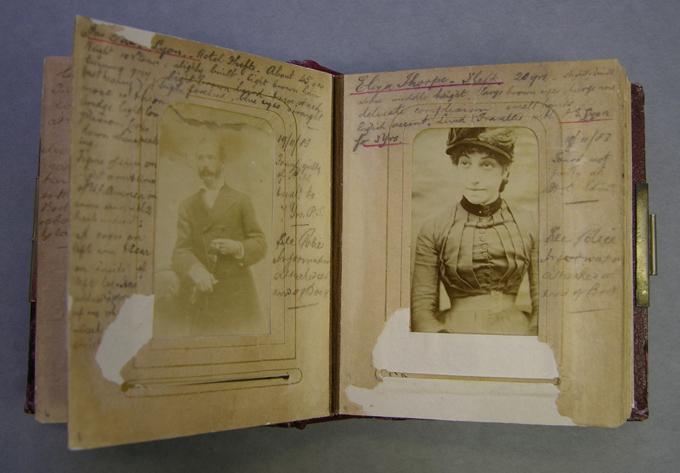
Notes in the photograph album described 45-year-old James Lyon: Weight 10 stones, slightly built, light brown hair turning grey. Light brown beard & moustache (not heavy), high forehead, blue eyes. Straight nose with … on bridge, light complexion. Looks down when speaking. Figure of ship on right arm & arms of U.S. America on same arm with 2 hearts under it. A cross on left arm & scar on inside of left leg.’ (NRS, AD5/32)
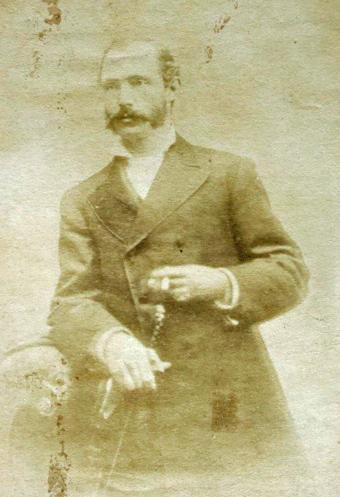
NRS, AD32/5
Eliza’s particulars were also recorded: ‘20 years of age, slight built, above middle height, large brown eyes, large nose, delicate complexion, small hands, has English accent. Lived & travelled with Jas. E. Lyons for 3 years.’ (NRS, AD5/32)
They appeared before Bailie Hall at the Police Court in Edinburgh where they were being remitted on the charge of the crime of theft committed in Argyll. They were then removed to Inveraray Prison where they were admitted on 17th August 1883.
Joseph Dowling, a 41-year-old club manager from England, was admitted to the prison a few weeks later on 7th September. He had been arrested under the charge of ‘theft or reset of pocket book and money.’ Dowling knew the two other prisoners; he had worked with them by accepting the stolen items with a view to reselling or benefiting from them.
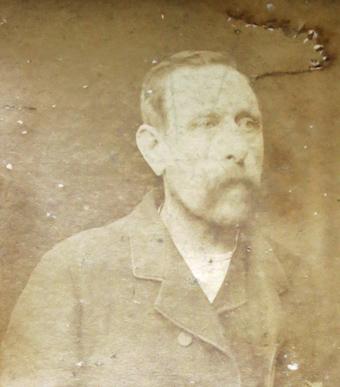
NRS, AD32/5
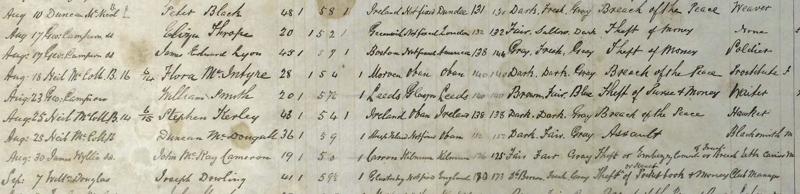
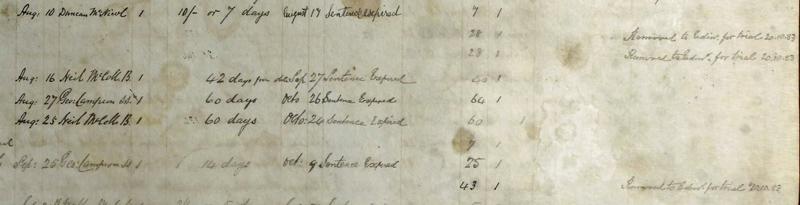
Crown copyright, NRS, HH21/35/4 page 97
All three prisoners were removed to Edinburgh for trial on 20th October 1883.
There were 44 productions in the case, and 85 witnesses (NRS, AD14/83/39). The prisoners Lyon and Thorpe were defended by the Dean of Faculty, John Hay Athole Macdonald, later Lord Kingsburgh, while Mr Galloway appeared for Dowling.
Evidence focused on stolen bank notes and a pocket book taken from Mr Miller’s clothing in his hotel room in Oban. Dowling had been found to be in possession of the pocket book upon his arrest in Ballater on 13th August, and Lyon was found with Mr Miller’s bank notes and two lockpicks. In a trunk belonging to Thorpe, the police found the black shawl belonging to Miss Janet Nicol.
The Dean of Faculty addressed the jury on behalf of Lyon and Thorpe. He argued that they had been living and travelling together for three years, had never concealed their movements, and never changed their names to conceal their identity. Furthermore, he claimed that despite Lyon being found with pincers and instruments that could open doors, there was no evidence that they had actually been used to steal anything; the serrated edges would have made grasping items in the way the prosecution accused, almost impossible.
The defence further claimed that the stolen bank notes in Lyon’s possession had been given to him by a Frenchman with whom he traded French notes. He suggested there was no evidence at all against Thorpe to say she had taken the black shawl. In fact, Lyon could have found it on the stair in the hotel, assumed it belonged to Thorpe and put it in her trunk.
At 5.38pm the jury retired to consider their verdict. They returned 12 minutes later.
Dowling was found guilty of reset (the crime of dishonestly possessing, receiving or keeping property that has been stolen, embezzled or obtained by fraud, knowing it to be dishonest). Lyon was found guilty of theft and Thorpe not proven.
Lord Young, addressing Thorpe before her release, said: ‘I hope you will have some one to put you in a way where you will have some chance of well-doing. It is not my duty to preach to you, and you are discharged.’ Thorpe embraced and kissed Lyon before leaving Court to the sound of cheering and hissing from the gallery.
The following day Lord Young characterised the case as ‘most remarkable.’ The circumstances, he said, were not favourable to the prisoner who had sought out opportunities to steal. Furthermore, stealing from hotel guests in their private spaces made him ‘about the meanest character that existed.’ In order to dissuade others from doing the same he sentenced Lyon to seven years imprisonment. Thorpe, watching from the gallery, became upset and quickly left the court.
Dowling had been proved to be the companion and associate of Lyon. Lord Lyon pronounced a sentence of imprisonment for 12 calendar months with hard labour for the crime of reset. (Dundee Courier, Friday 23rd November 1883)
Sources/further reading
Campbeltown Courier, Saturday 28th November 1903
The Inverary Gaol and Courthouse Act 1814
Scottish Legal News. Our Legal Heritage: Inveraray Jail and Courthouse
History Hit website: Inveraray Jail
Statistical Accounts of Scotland: Island of Islay, Parish of Kilchoman
Precognition against Mary McGlashan for the crime of child murder, 1864, NRS, AD14/64/124
Inveraray Prison Governor’s Journal (1847-1880), NRS, HH12/57/1