Images from 20 registers for Ayr Prison covering the period 1841 to June 1911 have been released on Scotland’s People capturing the details of men, women and children held in the institution. Over 98,000 entries are now available to search, view and download online. These records document children as young as six and adults as old as 91 as being imprisoned. They came from across Scotland and the wider world including America, Tasmania, Switzerland and South Africa.
This article will explore the history of the prison and share the stories of some of the prisoners sentenced to death for their crimes, who were held within Ayr’s ‘condemned cell’.
The prison
The 19th century prison was constructed between 1818 and 1822 and sat on Wellington Square, Ayr.
This replaced the ‘Old Jail’ (or tolbooth) which had been built around 1575 and had stood in the centre of the town.
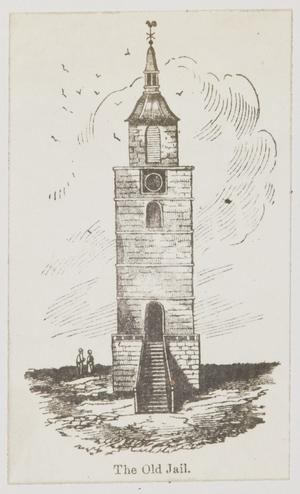
Credit: SC2423211 © Crown Copyright: HES (Records of the Ordnance Survey Archaeology Division, Edinburgh, Scotland). Illustration from 'Reminiscences of "Auld Ayr"', 1864
Striking in design, it was accessed from the street by 19 steps to the doorway, and was topped by a steeple surmounted by a spire 135 feet in height. A clock at the top was known as ‘the drowsy dungeon clock’ in Robert Burns' poem ‘Brigs of Ayr'. However, its poor positioning in the town caused issues and contemporaries described how it ‘interlines and almost blocks up one of the principal streets. Security is the only consideration, which seems to have gained the attention of those who planned this public nuisance, which is not so much the terror of evil doers, as the horror of those who do well.’ (Source: The New Statistical Account of Scotland)
This building was demolished in 1825.
The new prison was designed by architect Robert Wallace (c.1790 – 1874). It took the form of a classical Courthouse, being based on the temple of Isis in Rome. The construction cost £30,000; The Bank of England inflation calculator estimates this to be the equivalent cost of around £2.5 million today. It was comprised of two stories, with an entrance in front, decorated by large circular columns made of stone from Arran. The interior had ‘a very handsome lobby, lighted from the top by a magnificent dome, rising to a considerable height above the whole building… The lower part of the buildings is laid out in offices for gentlemen officially belonging to the law courts… The upper storey consists chiefly of two large halls with anterooms for the judges and gentlemen of the court, and retiring rooms for the jury and the witnesses. One of the halls forms the Justiciary Court Room, and can hold upwards of 600 people.’ (Source: The New Statistical Account of Scotland)
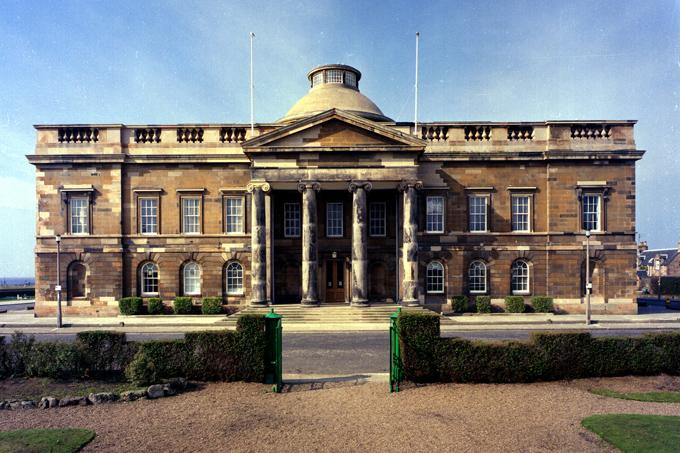
Credit: SC336941 © Crown Copyright: HES
The building was designed with security as a priority but the locality of the prison was also considered. Contemporaries praised the location being near to the sea as being beneficial for the inmates’ health. Indeed, it became known, by prisoners, as ‘The Cottage by the Sea’. In the ‘old jail’ men and women were able to spend the day together ‘wherein by intercommunion of evil speech and depraved passions, they were rendered more wicked and profligate than ever, the incarceration made them worse, instead of reforming them.' (Source: The New Statistical Account of Scotland) The new prison separated sexes into different areas and each prisoner was housed individually.
Work began for inmates every day of the week at 6am, with hard labour lasting around 12 hours. Prisoners also picked oakum (the fibre obtained from short lengths of rope that had been teased apart) or were taught weaving as a way of developing a skill for them to use upon release.
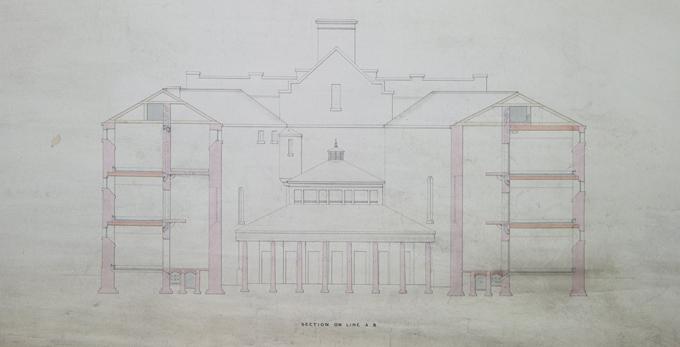
Crown copyright, NRS, RHP21332
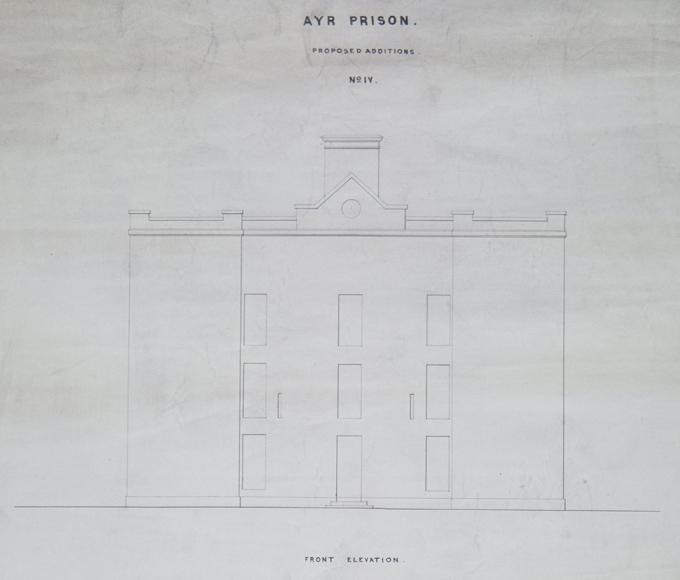
Crown copyright, NRS, RHP21332
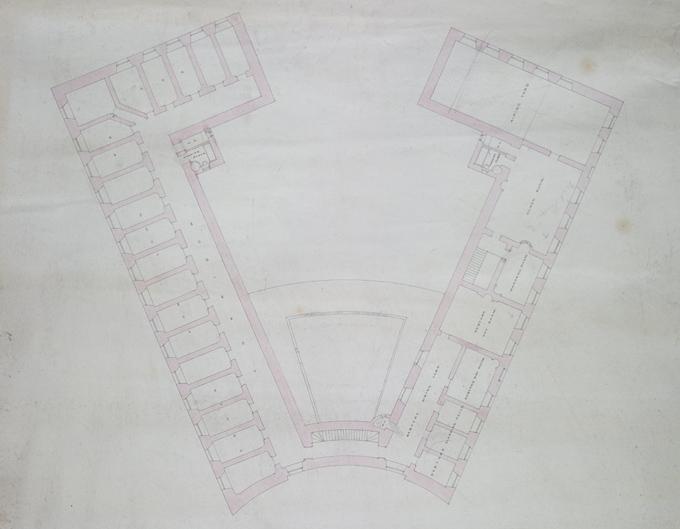
NRS, RHP21331
In the 1840s, further additions were made to the building, designed by the architect Thomas Brown. In 1837 he had been appointed as architect to the newly formed Prison Board of Scotland with the purpose of modernising and improving prison facilities across the country. The 1840s witnessed improvements to Ayr more widely. At this time the town had a population of around 16,500 inhabitants and they benefited from the new additions which included ‘handsome new buildings on the side of Wellington Square and Barns’ Street… The county buildings, the lofty tapering new spire, and the imposing Gothic-like erection of Wallace Tower, have tended much to beautify and adorn the town, and to add to the effect of its appearance, when seen from a distance.’ (Source: The New Statistical Account of Scotland) Ayr’s courts included the sheriff court, small debt court, commissary court, a burgh and criminal court and a justice of the peace.
At this time, around one third of prisoners in Ayr Prison were female, with the majority having committed theft. A majority of the male prisoners had committed acts of theft or assault.
Further additions were made to the building in the second half of the 19th century including pavilions added to the south (1863-1865) and the north sides (1874). From 1880, with the closure of Kilmarnock Prison, Ayr became the only active prison in Ayrshire, containing 149 cells.
In 1929, however, The Local Government (Scotland) Act was passed which increased the responsibilities of Ayr County Council. The Victorian prison was considered inadequate for purpose and prisoners were sent to the newly expanded Barlinnie Prison in Glasgow. Ayr Prison was closed in 1930.
The firm Charles Brand, based in Dundee, secured the contract for demolition which took place in 1931 and Ayr Town Hall was built on the ground previously occupied by the prison.
Today, underneath the town hall, sit 12 Victorian prison cells, built in 1878. Instead of housing prisoners, however, they are now used for storage.
The Condemned Cell
Joseph Calabrese
Joseph Calabrese was born in Naples, Italy c.1868 to parents Negandro Calabrese and Sarah Fikini [Ficini]. He settled in Scotland where he worked as an ice cream vendor.
On 28th December 1897 he married Jessie McKenna, the 23-year-old daughter of John McKenna and Isabella McGregor at St Bridgets Roman Catholic Church, Kilbirnie. Ten days later, on 18th December, their first child, a daughter, was born at Craighouse Square, Kilbirnie. Registered as Antonia, she was later known as Minnie. Her birth was registered on 21st March the following year.
Their second child, a son, Thomas (later known as Tommy), was born on 19th August 1899 at 60 South Albion Street, Glasgow. Another son, John, was born on 27th November 1890 at Glengarrock, Dalry, Ayr.
The 1901 census enumerates the family living in Dalry.

Crown copyright, NRS, 587/12/17
The family then returned to Kilbirnie, where their final child, a daughter named Lucinda, was born on 1st March 1903.
It was in their family home, in Kilbirnie, that Joseph murdered his wife and children, in the early hours of Friday 15th April 1904. He was admitted to Ayr Prison the same day.
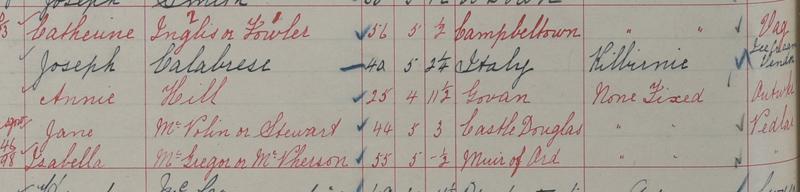

NRS, HH21/27/19, page 149
Joseph’s wife, Jessie, was known to be an alcoholic. On the evening of 14th April 1904, having become intoxicated, she was helped home from Joseph’s ice cream shop by Catherine Taggart, a mill-worker, at around 10pm. Catherine put the children to bed and left around midnight as Jessie was also preparing to sleep. Joseph had returned home between 12 and 1am. He rose from bed multiple times to feed and calm their youngest child. When he asked Jessie for help, he stated that she had reacted angrily at having been woken and swore at him.
On being examined on 8th May by Professor Glaister, a forensic scientist, general practitioner and police surgeon, Joseph recounted that his wife had threatened to split his head with a hatchet, but instead she hit his chest with the blunt end. An argument ensued. The couple had had a fractious relationship and during periods of drunkenness Jessie had often antagonised Joseph with the taunt that he was not the father of his children. On the fateful night of the murder, the children were woken by the fighting and got into bed with their mother, throwing coal at Joseph. The two eldest, together with their mother, shouted at him that he was not their father.
In a rage, Joseph grabbed the hatchet and murdered his family. Afterwards he got dressed and reported himself to the police.
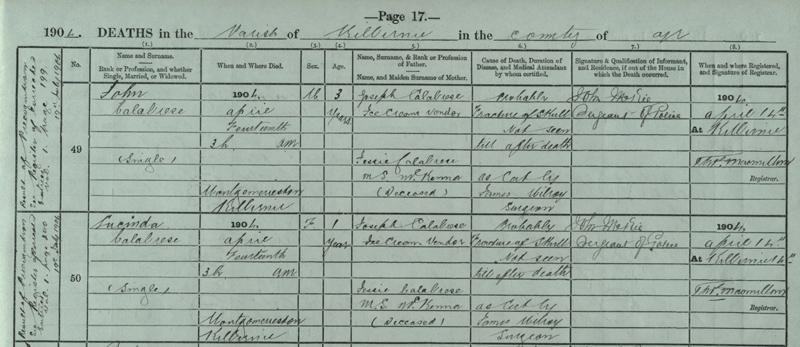
Crown copyright, NRS, Statutory Register of Deaths, 1904, 596/50 page 17
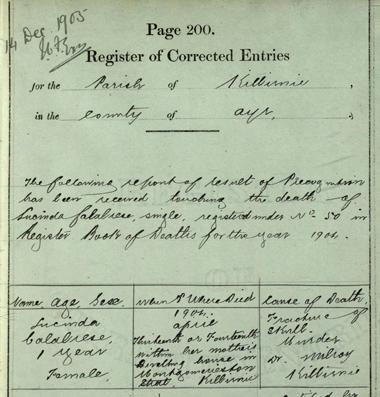
Crown copyright, NRS, Register of Corrected Entries, 596/00 001 200
On Friday 15th April 1904 Joseph was formally examined before Sheriff Mackenzie at Kilmarnock. He withheld any statement regarding the crime and was committed to Ayr Prison for further inquiry. The media reported that ‘the unfortunate man maintained a stolid demeanour and did not seem to realise the gravity of his position.’ (Source: Edinburgh Evening News 16th April 1904)
An indictment for murder was served upon Joseph in Ayr Prison on 22nd April.
At the trial at Glasgow High Court, Dr Naismith, surgeon to the County Hospital and Prison of Ayr was called for the defence. He had had Joseph under his care for 15 days in Ayr Prison and believed that when he was admitted he was not responsible for his actions. He argued that Jessie’s cruel taunts and continuous bad behaviour to him over a sustained period of time had led to him developing ‘irresistible homicidal impulses.’
The jury retired just before 4.30pm and deliberated for 30 minutes. Joseph was found to be unanimously guilty of murder however the jury recommended him to mercy on the grounds of extreme provocation.
Lord Adam passed a sentence of death. Joseph’s reaction to this was reported to be one of confusion.
He was imprisoned in the ‘condemned cell’ at Ayr Prison where men and women waiting execution were held ‘under sentence of Death’. Calabrese received many visits there, ranging from the governor of the prison, to the Roman Catholic visiting clergyman, to the medical officer.
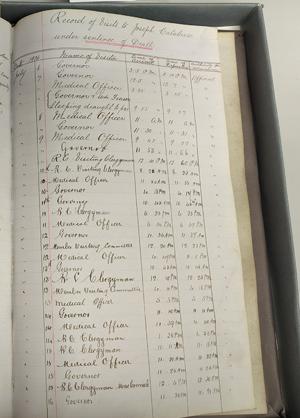
NRS, HH12/50/4
A file held in National Records of Scotland (NRS) records Joseph’s emotional state following the trial:
‘Calabrese is labouring under the delusion that he was to be executed on the 6th inst. He says that we are waiting to get an opportunity when he is sleeping to kill him. He also declares that he will not go to sleep lest we do kill him. Calabrese [was] restless & slept none in the night of the 6th and was under the delusion that he would be executed if he slept. Calabrese on the night of the 7th [was] restless & talked a great deal about being executed if he slept & wished it to be done quickly or he would do it himself. He slept from 1 to 2.50am & was quiet after.’ (NRS, HH15/3, Prisoner’s Record: Joseph Calabrese, 1904-1914)
A petition was sent to the Right Honourable Andrew Graham Murray, K.C., M.P., Secretary of State for Scotland, to appeal the sentence of execution. With the support of Dr William Naismith, Medical Officer for the Prison of Ayr, the appeal repeated Professor Glaister’s argument from the trial that Joseph had:
‘acted under an irresistible homicidal impulse produced by the long-continued and constant provocation which he had received from his wife, and the misery which she had by her drunken and theftuous conduct caused him during the whole period of their married life, resulting in the ruin of his whole career, and especially the oft-repeated accusations of want of virility, and taunts regarding the paternity of the children, with which she not only herself reproached him, but taught the elder children to repeat.’ (NRS, HH15/3)
Dr Landels Rose Oswald, physician superintendent at the Royal Asylum, Gartnavel, Glasgow, believed that Joseph may have suffered from ‘mental epilepsy’ and that the murder of the young children, clearly loved by him, indicated a weakness of mind amounting to insanity. He also reflected contemporary views of parenting responsibilities, arguing that ‘on account of his wife’s dissolute habits, to take upon himself those duties towards his children which are regarded as the duties of a mother and that he has hitherto…born an irreproachable character, and gained the highest esteem from his fellow-citizens in every place where he has resided.’ (NRS, HH15/3)
On 27th July 1904 The Provost of Ayr received a letter confirming that the capital penalty had been commuted to penal servitude for life. The Provost Bailie Thomas Allan and the Governor of the prison visited Joseph in his cell to relay the news to him, to which he replied: ‘Thank you very much.’
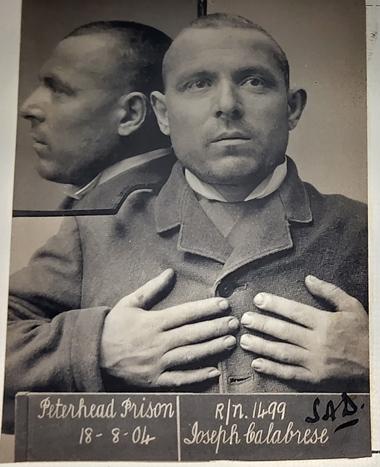
NRS, HH15/3
Joseph was sent to Peterhead Prison and was liberated from there on Saturday 5th August 1914. He was 50 years old. His conduct and industry in prison had been ‘good’ and he was recorded as having undertaken ‘labouring’ work whilst imprisoned to which he was to be paid a gratuity of £3. (NRS, HH15/3)
He returned to Italy at the end of 1914 to live in Venafro.
Thomas Bone (1897-1912)
Thomas Bone was admitted to Ayr Prison on 3rd April 1908 for the crime of murder.


Crown copyright, NRS, HH21/27/21 page 23
He was born in the parish of Muirkirk on 6th October 1879. His parents, William Bone, a coal miner, and Ferguson Kirkwood, a domestic servant, were unmarried. They married two years later, on 28th January 1881 in Glenbuck, Muirkirk.
Thomas grew up in Glenbuck, and, like his father, became a coal miner. On 27th April 1906, aged 26, he married his second cousin, 17-year-old Agnes Campbell Bone, a domestic servant. Thomas was a jealous husband and Agnes left him from time to time to return to her family when their relationship became strained. He regularly followed his wife to her work to cause disturbances, and had been convicted of assault, breach of the peace and malicious mischief.
By the spring of 1908 Agnes was working at Raith Farm near Monkton, around 40 miles from where Thomas was living. She returned to Glenbuck to visit friends on 2nd April 1908. Thomas, having seen her passing, sent a message asking to meet. They went for a walk together and took shelter from a storm in a farmhouse. When the weather cleared, they returned to the path where witnesses, some distance away, later saw Thomas stamping on the ground, picking up a stone and throwing it forcibly towards the floor.
Thomas returned to Glenbuck and admitted that he had ‘murdered his wife in a fit of temper.’ Agnes’ body was found on a path; her head ‘was terribly smashed, being literally crushed in on both sides.’ (Source: Dundee Evening Telegraph, 19th November 1912)
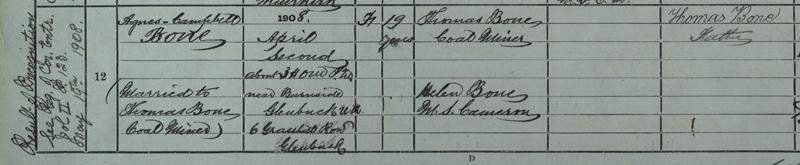
Crown copyright, NRS, Statutory Register of Deaths, 607/12 page 4
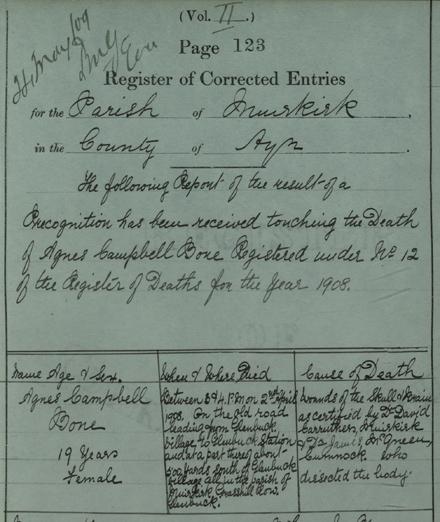
Crown copyright, NRS, Register of Corrected Entries 607/00 002 123
The case was heard at the High Court in Glasgow where Bone ‘winked to witnesses, and occasionally interrupted the proceedings by flippant remarks. And when Lord Ardwell pronounced the death penalty, Bone jumped to his feet and thanked Lord Ardwell; he had a higher power to meet and was prepared to face it. That day the prisoner was conveyed back to Ayr Prison…[where] his attitude was one of great callousness and stolid indifference. But as the day of execution drew nigh he began to realise the seriousness of his position, and appeared to be much affected.’ (Source: Thomson’s Weekly News, Saturday 6th June 1908)
Thomas’ death sentence was later reduced to life imprisonment. When the news reached him, he had been sitting reading the New Testament. He reacted badly to the news and ran to a corner of his cell, crying out that he wanted to be with his wife. Mr Walker, the prison chaplain gently calmed him.
Thomas was subsequently certified ‘insane’ and transferred to the Criminal Lunatic Department in Perth Prison.
On 15th November 1912 Thomas was found dead in his cell; he had hanged himself using his bedsheets.
In the week following Thomas’s death, an anonymous writer in The Dundee Evening Telegraph wrote about his experience visiting Thomas in prison. His demeanour, he said, had been sullen and his ‘listless eyes stared out at the expanse of wooded hills beyond the prison walls.’ The author described the prisoner: ‘short stature and slimly built. He wore a slight moustache, and had large blue eyes.’
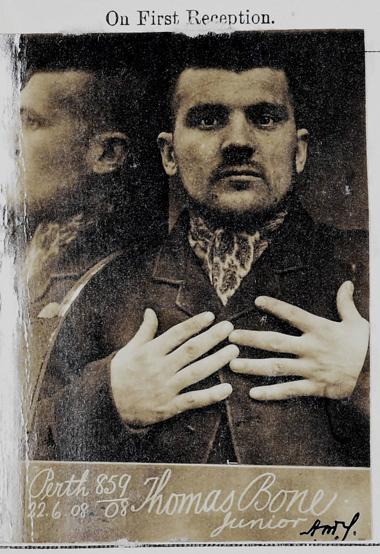
Crown copyright, NRS, HH15/22 page 3
Mary Boyd
On 4th September 1888, 60-year-old Mary Boyd, from County Antrim, Ireland, murdered her two-year-old granddaughter, Jane in her house in Borestone, Dalry, Ayrshire. She was admitted to Ayr Prison on 6th September for the crime of murder.
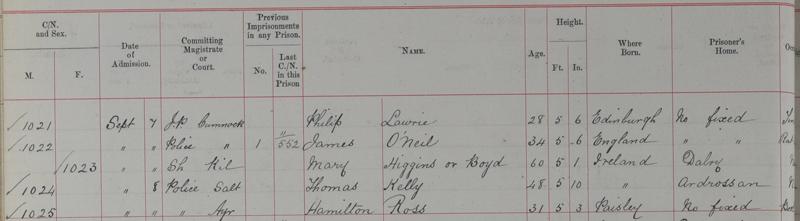
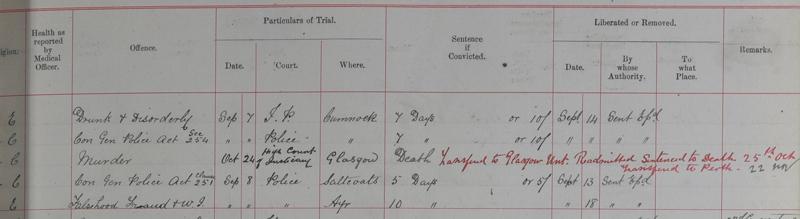
Crown copyright, NRS, HH21/27/13 page 34
Jane had been born illegitimately to Mary’s daughter Sarah on 12th July 1886 in Kilbirnie, Ayr. Sarah had married William McGill, a 45-year-old iron miner in Dalry, Ayr, on 13th September 1880 when she was 20 years old. William died on 9th July 1883 from ‘morbus brightii’ (Bright’s Disease); a 19th century term for kidney disease. In late 1885 Sarah became pregnant out of wedlock by Terrance McGinn, a general labourer. He refused to support either Sarah or the child.
Sarah could not work and look after her baby, and asked her mother to raise the child when she was around six weeks old. In March 1887, Mary took out an insurance policy which would pay 30 shillings if the baby died and contributed one half penny per week towards the plan. Neighbours often noticed how delicate Jane was and that she appeared to be an ‘uncared for wean [child].’
Sarah sent five shillings to her mother every fortnight to help with costs. In August 1888 Sarah visited her family and noticed that the young child ‘seemed to be in bad health – [it] began with teething and my mother said it was a slow decline. In August it was very poorly in health.’ (NRS, JC36/1)
A few weeks later, Jane was murdered by Mary.
On the evening of 4th September 1888 Mary Boyd visited her local doctor, Dr John Archibald, to inform him of the child’s death and asked him to provide a certificate. The Dr refused, as he wanted to see the child first. The next morning, at 8am, Mary called in to see Dr Archibald, again to request a death certificate. In his evidence, he claimed that he did not want her to have to come back in to the town again, so he signed a certificate, listing ‘emaciation’ as the cause of death.
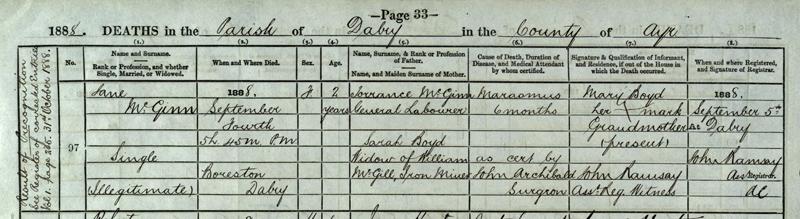
Crown copyright, NRS, Statutory Register of Deaths, 1888, 587/97 page 33
Dr Archibald had attended Jane fairly regularly since July 1887 and knew the child. The day after her death he visited the family home to see her body and was met by a neighbour, Mrs McDermott. She told him that she had seen Jane and warned that ‘all was not right in connection with the case.’ He asked Mary to remove Jane’s clothes and saw an incised wound about half an inch long under the right arm. Dr Archibald questioned Mary about the cut and she explained that ‘it often played with her grandfather’s knife in the cradle. [Mary’s] husband was sitting by and said ‘You know perfectly well that the knife was not in the cradle yesterday.’ She then said ‘But the scissors were.’ (Source: Glasgow Evening Citizen, Thursday 25th October 1888)
A post-mortem examination of Jane’s body by Dr McVail, Kilmarnock, confirmed that the cause of death was by a deep wound inflicted to the heart and lungs, probably caused by a pair of scissors. The wound could not have been caused by the child playing with scissors as it wouldn’t have inflicted sufficient force. The post-mortem results are reflected in the ‘Register of Corrected Entries’, and the findings are reflected in the cause of death: ‘stab wound penetrating heart and lungs.’
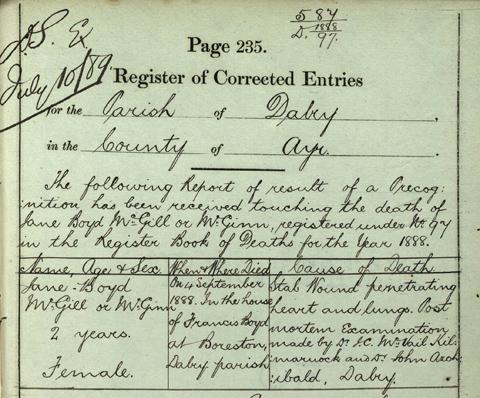
Crown copyright, NRS, Register of Corrected Entries, 587/00 001 235
Seven pairs of scissors formed part of the evidence in the trial (NRS, JC26/1888/90). It is unusual for physical items of production to be retained with the case papers, however these have all survived. The NRS Conservation Team have carefully wrapped and boxed each set of scissors separately from the archival records for preservation. Now 138 years old, they have rusted, but have only been lightly cleaned by Conservation. This is due to their involvement in the case, and the awareness that residue of evidence may remain.
During Mary’s trial in Glasgow, she claimed that she had first noticed the wound when washing the baby’s body after her death and saw blood in the water. She denied being responsible for Jane’s death. The prosecution claimed that Mary had murdered Jane for the insurance policy money.
On Wednesday 24th October 1888, the Advocate-Depute, Mr Duncan Robertson, asked the jury to return a verdict of wilful murder against Mary. The jury retired to consider their verdict, returning to the court after 25 minutes. Mary was found guilty but a large majority of the jury recommended her to mercy. Mary showed no outward signs of emotion.
Lord Shand passed the death sentence, which was to be carried out on 14th November 1888 in Ayr Prison.
An appeal for the commutation of Mary’s sentence from death to servitude for life was submitted to the Secretary for Scotland, Schomberg Kerr, the 9th Marquess of Lothian (often referred to as Lord Lothian). This was on the grounds of her sex and age, and in view of a recommendation of mercy by a majority of the jury. Lord Shand, who had ruled in the case, wrote to the Lord Justice Clerk to give further thoughts on the case:
“…the child which was given to [Mary’s] care was a hard burden on her…I do not think the insurance money was the motive of the murder…I rather think…that the child was felt to be a grievous burden. The insurance money was however a full provision for financial expenses & prevented the child’s death from creating an expense would could not be met. The case was one in which the murder was certainly committed… it was not clear however that the emaciated condition of the child was not caused by want of proper nourishment but whether the prisoner had the means of giving such nourishment did not appear.” (2nd November 1888, NRS, HH16/62)
On 10th November 1888 Lord Lothian approved the commutation of Mary’s sentence to servitude for life.
Mary was sent to Perth General Prison. From January 1893 to the spring of 1895 Mary wrote to the Secretary for Scotland to ask for consideration for release due to her age and poor health. She said that, if released, her son and daughter could assist her, or she could go to the ‘Home of the Little Sisters provided for old women.’ Each request was rejected. On 13th March 1895 the prison doctor noted that ‘Convict is a frail old woman who has suffered from chronic bronchitis more or less since admission…and she has been repeatedly under treatment for chest symptoms during the past few years’ (NRS, HH16/62)
Mary died on 4th May 1897 in the Sick Hospital of Perth General Prison from chronic bronchitis and congestion of the lungs. Her death entry was signed by a warder from the prison.
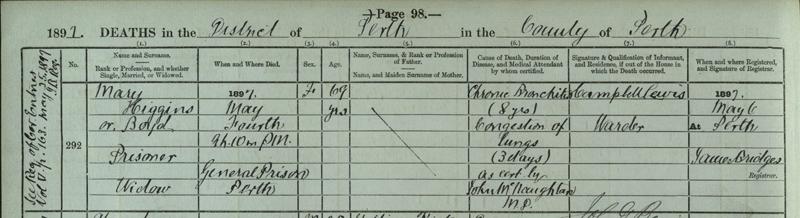
Crown copyright, NRS, Statutory Register of Deaths, 387/292 page 98
Sources/further reading
Dundee Courier, Friday 6 December 1929, page 5
Dictionary of Scottish Architects, building search
Dictionary Scottish Architects, architects search
Fivefold Tragedy at Kilbirnie. The Daily News (Perth, WA), 13th October 1904
Scottish Places - a historical perspective of Ayr
Statistical Accounts of Scotland - The Parish of Ayr
Cumnock Chronicle - Shadow of the Noose, A Higher Power
Prisoner's record: Joseph Calabrese, 1904 - 1914. NRS, HH15/3
Criminal case file: Joseph Calabrese, 1904 - 1914. NRS, HH16/103
Trial transcript from the trial of Mary Boyd for the crime of murder. 24 October 1888. NRS, JC36/1
Trial papers relating to Mary Boyd for the crime of murder. 24 October 1888. NRS, JC26/1888/90