Introduction
Background
How to search Pensions Appeal Tribunals records
Understanding the records
Understanding medical information in the records
Related records held by NRS
Related records not held by NRS
Further reading
Glossary
Introduction
National Records of Scotland (NRS) holds almost 30,000 case papers relating to Pensions Appeal Tribunals for veterans of the First World War in the PT6 series of records. Records over 100 years old can be searched and viewed on Scotland’s People.
The tribunals were set up in the aftermath of the First World War to allow disabled veterans and their dependants to challenge decisions made by the Ministry of Pensions.
The records are the case papers for Scottish ordinary servicemen and non-commissioned officers. No similar records survive for England and Wales for this period.
The case papers contain significant amounts of medical, personal and military information which use terms and language from the historical context. As such, there are references to historical terms that are no longer accurate or acceptable.
The Wellcome Trust funded work to prepare these records for release.
Background
War Pensions
Before the First World War, military pensions were administered by a variety of different organisations. By 1917, however, the number of war casualties made it necessary to create a single body, the Ministry of Pensions, with responsibility for administering the disability pensions of men who served during the war.
To receive a disability pension, an ex-serviceman’s medical condition had to have been assessed as either caused by (attributable to) or made worse (aggravated) by his war service. If it was decided that a disability was not caused or aggravated by the war, a man may have been granted a gratuity (a one-off financial payment) or final weekly allowance, instead of a pension.
The amount of pension a man received was based on his rank and the degree of his disablement. For example, a man who lost a hand and a foot was assessed as 100 percent disabled. If he lost two fingers, he was considered to be 20 percent disabled. If he was judged to be less than 20 percent disabled, he would only be given a temporary pension or a lump sum. Men could also apply for additional pensions if they had dependants or if their disability meant they were no longer able to make their pre-war earnings.
After he left the military, a man would attend various medical boards where his condition would be assessed by doctors. He might be offered treatment or occupational training. He would be paid a temporary pension until it was agreed that his disability had stabilised, at which point a ‘final award’ would be made.
If a man had died, and his death was considered by the Ministry of Pensions to be attributable to or aggravated by his war service, his widow or dependants could claim a pension.
Pensions Appeal Tribunals
It soon became clear that applicants needed a way to challenge decisions made by the Ministry of Pensions. In November 1919, Pensions Appeal Tribunals for Scotland were established under the War Pensions (Administrative Provisions) Act 1919.
There were three different types of appeal that a person could make:
- Entitlement Appeals: These enabled men to appeal a decision that a medical condition had not been caused or aggravated by war, or that a condition had only been aggravated by war. A man could also appeal if he had been given a temporary pension because it was decided that any aggravation from war would pass or had passed away. Finally, a man could appeal if his pension had been rejected on the basis of his serious negligence or misconduct.
- Entitlement Appeals for Widows and Dependants: Widows, children, parents or dependants could appeal against the decision that the man’s death, or the disease that caused his death, was not attributable or aggravated by the war, or that it did not begin while he was on active service. If the Ministry of Pensions had decided that his death was due to his serious negligence or misconduct, this would also be grounds for appeal.
- Assessment Appeals: In 1921, the power of the tribunals was extended to enable men to appeal against the final award they had been granted by the Ministry of Pensions.
To appeal, applicants had to submit a form through their Local War Pensions Committee stating the grounds on which they were appealing. They were expected to gather evidence to support their appeal, including certificates from their health insurance society, doctor and employer. The tribunal could also request additional reports from specialists or ask expert witnesses to appear at the hearing.
A précis (or summary) of evidence relating to the case was created by the Ministry of Pensions and sent to the tribunal. The applicant would also receive a copy of the précis before the hearing.
Scottish tribunals sat in Edinburgh, Glasgow, Aberdeen and Dundee. Entitlement tribunals were made up of a solicitor, a disabled man, and a medical practitioner. Assessment tribunals had two medical practitioners and a disabled man.
Applicants were expected to attend hearings in person, unless they were too ill to travel. Applicants could be accompanied by a friend or legal advisor for support and to ask questions. They could also bring a doctor or other witness. Once the evidence had been presented, medical members of the tribunal would examine the man (if he consented) before retiring to make a decision. Applicants were informed of the outcome of their appeal at the end of the hearing. The tribunal’s decision was final.
How to search Pensions Appeal Tribunals records
How to search
You can search and view Pensions Appeal Tribunals records using the searchable index in the ‘Legal records’ area of the website. Searching the records and browsing the summary information provided in the search results is free of charge. Viewing images of the original records costs 20 credits.
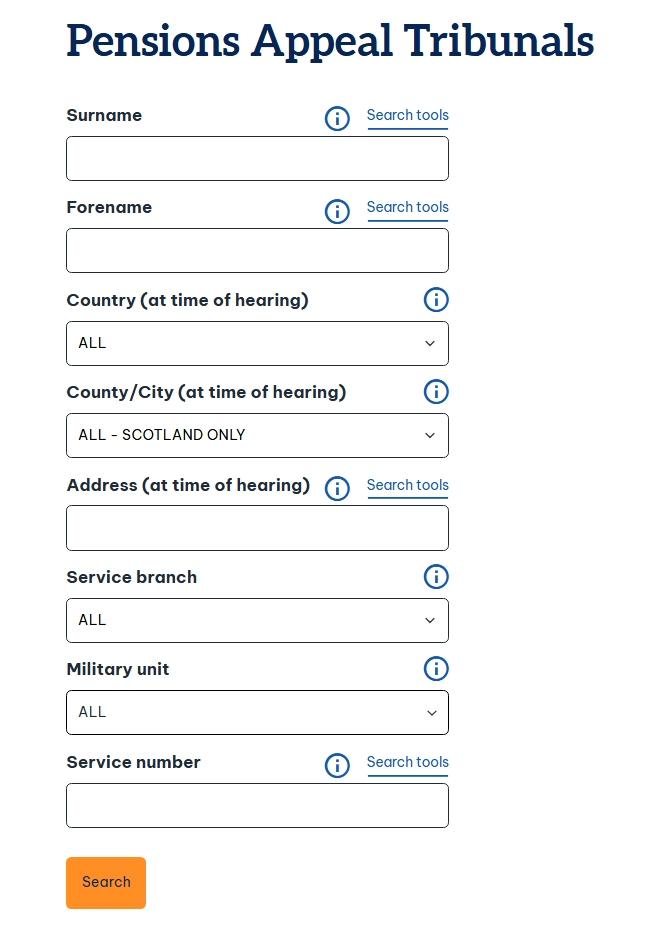
You can search Pensions Appeal Tribunals records using some, or all, of the following index fields:
- Surname
- Forename
- Country (at time of hearing)
- County/City (at time of hearing – Scotland only)
- Address (at time of hearing)
- Service branch
- Military unit
- Service number
Crown copyright, NRS
The search form includes search tips for each field and there are search tools available for some of the fields (Surname, Forename, Address, Service number) to enable you to tailor your searches in various ways.
The country recorded in the index is the one in which the appellant was living at the time of the appeal. The appeal could have been lodged by the individual themself, or by a family member if the serviceman had already passed away. Most of the appeals were made by people living in Scotland, but some were made from England, Ireland and overseas.
County information is only available for locations in Scotland. Due to changes in boundaries over time, the county recorded might not be the same as the modern county in some locations.
Where multiple addresses are included in the record, the address at the time of the appeal hearing has been used in the index. You can type all or part of an address into the search field. A search for ‘High’, for example, would return a result for ‘59 High Street, Peebles’ as well as ‘Bellefield Farm, High Blantyre’.
A service (or military) branch is a distinct, primary subdivision of a nation’s armed forces that specialises in a specific operational domain such as land, sea or air. If you have information about the service branch relevant to your search, you can select ‘Air Service’, ‘Army Service’ or ‘Naval Service’ from the drop-down list. You are then able to further refine your search by selecting a military unit (e.g. a regiment, battalion or corps) from the available drop-down list. You can scroll the alphabetical list to locate an entry, or you can search for entries using the search field, in which you can search for all or part of the name of a military unit. Typing ‘Yor’, for example, will return several entries, including ‘Alexandra, Princess of Wales’s Own (Yorkshire Regiment)’, ‘West Yorkshire Regiment’, and ‘York and Lancaster Regiment’. Where someone served in more than one branch or military unit, all of these have been recorded in the index.
A service number (often called a regimental number) is a unique identifier assigned to enlisted military service personnel by their specific regiment or corps. Pensions Appeal Tribunals records contain service numbers for most service personnel – these can also be searched on the form.
Results page
Crown copyright, NRS
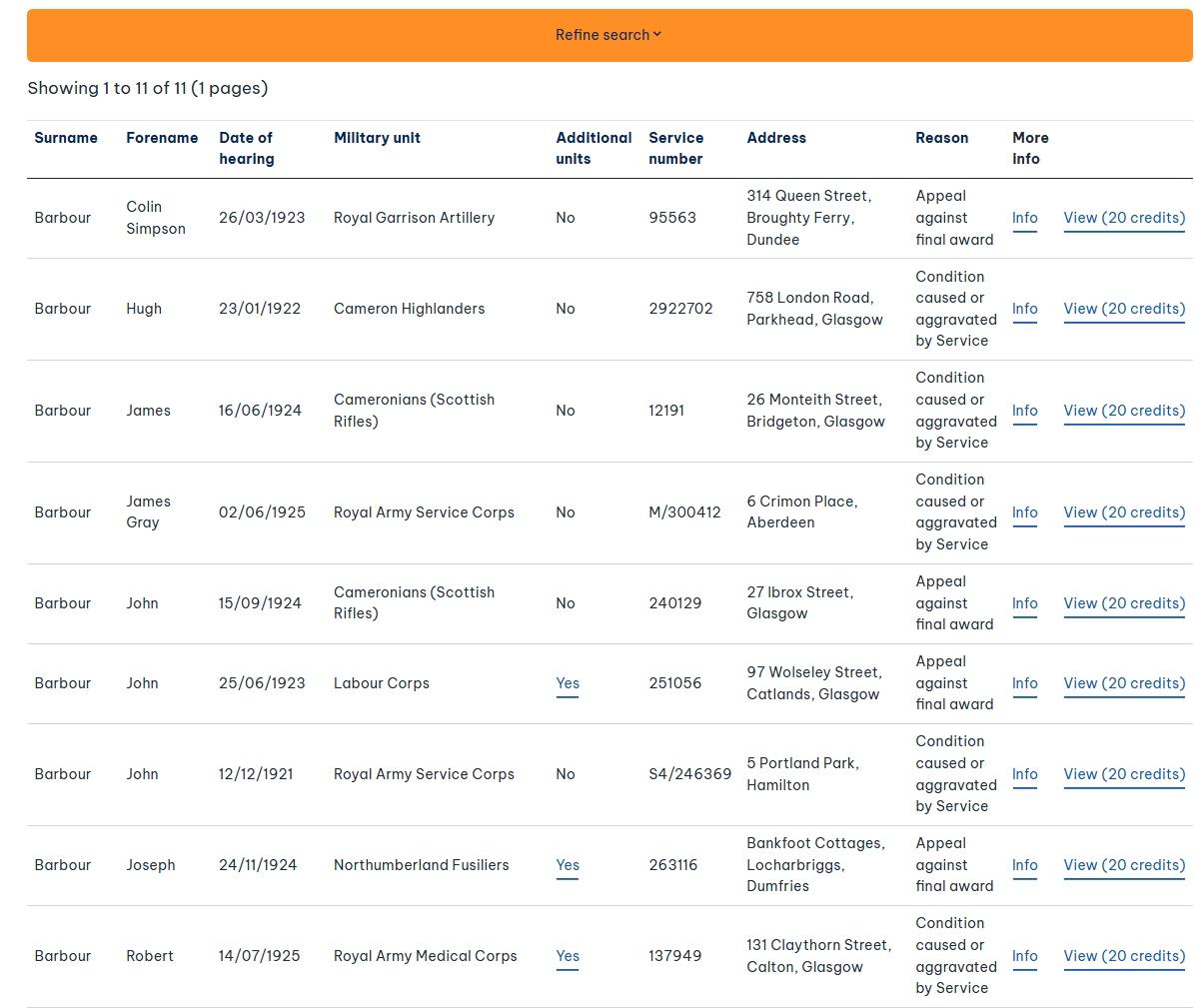
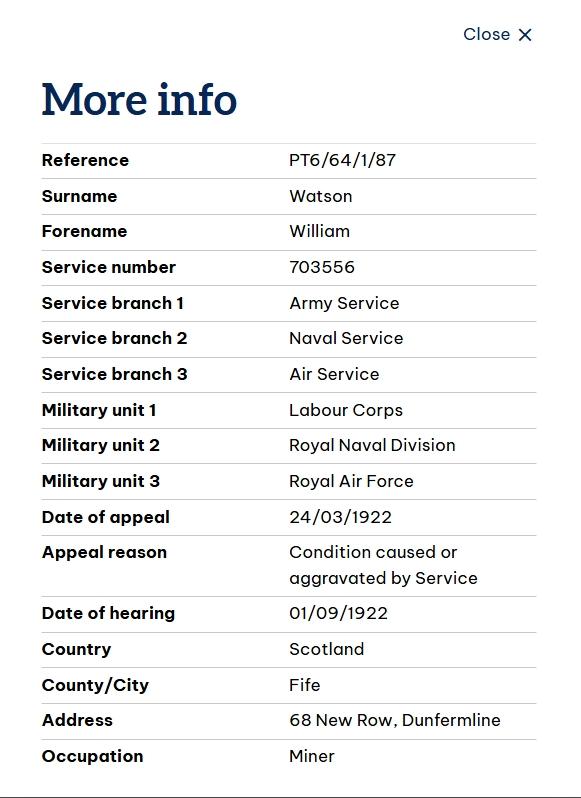
The results page displays the following information: Surname, Forename, Date of hearing, Military unit, whether there are additional military units associated with the record, Service number, Address and Reason for the appeal. If the result indicates that the person served in more than one military unit, you can click on ‘Yes’ to view these. You can also click on ‘Info’ in the ‘More info’ column to view additional details.
Crown copyright, NRS
Using the sort function on the search results page allows the information in that column to be sorted alphabetically or by date, whichever is relevant.
Where no data was recorded or the information was stated as unknown, the entry will usually show a series of hyphens, i.e., -----.
Names are captured as they are given on the returns. Reasons for a name not appearing as expected might include:
- Misspelling, phonetic spelling or other misinterpretation
- Surname variants
- Forename variations, including abbreviations, use of diminutives (for example, Alex for Alexander), nicknames or middle names as first names.
Where place names have been recorded with a generally accepted spelling, they have been included as written. However, it should be noted that the information in these records was self-reported and place names might include errors made by tribunal staff. To assist searching, in a small number of instances, NRS has standardised these variations of spellings to provide some consistency.
The self-reporting of information also means that military units have not been recorded consistently, and in many cases use abbreviations. Again, where there are apparent inaccuracies, NRS has standardised military unit names to help return accurate results from searches.
Understanding the records
Pensions Appeal Tribunals records are the case papers relating to the hearings. These consist of:
- The decision page.
- The précis of the evidence.
- Additional reports or correspondence relating to the case.
Decision page
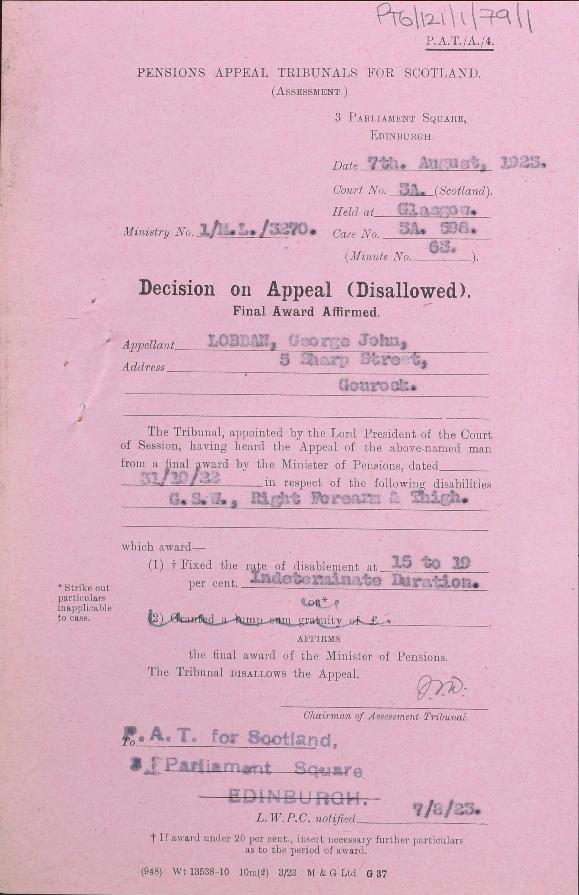
At the beginning of each record is a decision page. It records the decision of the tribunal. If the form is pink, the appeal was unsuccessful.
It was evidently very difficult for applicants to prove their case before the tribunal – over 70 percent of the cases in these records were ‘disallowed’. The case papers held by NRS provide us with a lot of evidence about the individual cases before the Tribunal, but the tribunals did not provide applicants with reasons for decisions.
Crown copyright, NRS PT6/121/1/79
Précis
This is a summary of the evidence relating to the case. It was created by the Ministry of Pensions and passed to the tribunal. The applicant and the person who was supporting them at the hearing were given copies in advance.
Please note that records can vary according to date or type of appeal, so you may find that some records provide more or less information than outlined below.
Administrative information
- The reason the Ministry of Pensions rejected the claim. This can be found on the front page, but a fuller explanation is usually found at the end of the précis.
- Where and when the hearing took place.
- Case number of the hearing.
- The applicant’s pension number.
- When the application was made.
Personal details
- Name of ex-serviceman.
- If the claim is being made by a dependant, they will also be named. Children were represented by their guardians, and it is common that children are not named at all in the record.
- Address or place of death.
- Age at date of appeal or death.
- Occupation and employer details.
- Name of doctor.
- Health insurance provider (sometimes called Approved or Friendly Societies), and any awards they made to him.
- A statement from the applicant.
Most of this information will be found in the first section of the précis. However, additional statements and certificates may be found throughout the record.
Military information
- The rank, unit and service number the serviceman was discharged under. This is usually provided on the line below the man’s name.
- Any other units he served in (including pre-war) and dates of service.
- Any foreign service (including pre-war) and dates of service.
- Why he was discharged, and any conditions he was discharged with. Men were usually either transferred to the reserve or discharged under King’s Regulations. For example, if a man was discharged because he had an illness or injury, his discharge reason would be given as ‘no longer physically fit for war service, King's Regulations paragraph 392 (xvi)’. If he had not been discharged with any conditions and had claimed a disability pension later on, this will be recorded as an Article 9 claim.
Medical information
- Extracts from forms created when he was in the military, including any hospital stays. For example, Army Form B 179A (A. F. B. 179A) was a medical report created prior to the man’s discharge.
- Details of medical boards he attended after discharge.
- If the man was deceased, it will also include details about his cause of death.
Additional documents
Some case papers include additional documents or correspondence relating to the hearing. These were usually bundled between the decision paper and the précis. They can include:
- Additional medical reports or statements. If a man was too unwell to attend the tribunal, he would be visited by tribunal members, and a report of their visit would be included as part of the record.
- A copy of the Chairman and the Medical Member’s notes if these were requested by the applicant after the hearing or if the man made further appeals.
- Any additional evidence or specialist reports requested by the tribunal.
Understanding medical information in the records
These records contain terms and language from the historical context. As such, there are references to historical terms that are no longer accurate or acceptable.
Men may have been diagnosed with conditions we no longer recognise. Their physical and mental health conditions were often described using language that is not acceptable today. How men looked and behaved are described in ways that we would now consider to be derogatory.
Thousands of different medical conditions are described in the records. These go beyond the usual injuries we associate with the First World War, such as gunshot wounds or gas poisoning. By trying to establish if a man’s disability was connected to war service, the Ministry of Pensions or tribunal may have collected evidence of his physical, mental and sexual health, including conditions he had before or after the war.
Related records held by NRS
Appeals against mandatory military service in the First World War for selected areas in Scotland are available to search and view on Scotland’s People. See our guide to Military Service Appeal Tribunal records.
NRS also holds 26,000 soldiers' and airmen's wills from the First World War, along with thousands of wills of soldiers who served in the Second World War and other conflicts between 1857 and 1965. These are available to search and view on Scotland’s People. See our guide to Soldiers’ and Airmen’s Wills.
Related records not held by NRS
As the British Armed Forces were administered from London, most surviving records of military personnel are held at The National Archives (TNA). For a useful overview of available records for the First World War, including service records for individuals, please see the TNA guidance on First World War records. As well as records held by TNA, the guide provides advice on some of the related records you can find in other archives and organisations.
For Pensions Appeal Tribunals held in England and Wales, case files dated earlier than 1957 were destroyed. Under reference BF 2, TNA holds around 700 files from tribunals held in England and Wales dating from 1957–93. TNA also holds files from the department responsible for war disability pensions under reference PIN 15, though these files are overwhelmingly administrative in nature. These include files on the constitution and working of the Pensions Appeal Tribunals.
For records held by TNA which relate specifically to disability and dependants’ pensions from the First World War, refer to the TNA guide. Please note that only a 2% sample of case files for pensions awarded (or refused) to First World War service personnel has been kept. Likewise, only a 2% sample of case files for pensions awarded to widows or dependants of First World War servicemen, from all branches of the military, has been kept.
During the First World War, entitlement to disability and dependants’ pensions were recorded in ledgers and a variety of record cards. The original records are in the care of The Western Front Association (WFA) but had previously been held locally, around the country, and then by the Ministry of Defence. These records have been digitised and can be accessed online. More information is available at The Western Front Association website.
Among the surviving service records held by TNA are records of non-commissioned officers and other ranks who were discharged from the Army and claimed disability pensions for service in the First World War (TNA reference WO364). These were also men who did not re-enlist in the Army prior to the Second World War. To understand the context of these records, and of how they can be accessed, refer to the TNA guide and to the catalogue reference for WO364.
Further Reading
- Hogge, J. M, War pensions and allowances (London, 1918)
- Instructions for the assessment of alternative pensions (HMSO, 1917)
- Ministry of Pensions, Local War Pensions Committees’ Handbook (HMSO, 1921)
- Ministry of Pensions, Notes on war Pensions (HMSO, 1926)
Glossary
List of Common Military Abbreviation
Abbreviated Rank | Rank |
| Pte | Private |
| Sgt | Sergeant |
| Spr | Sapper |
| AM2 | Air Mechanic 2nd Class |
| ASS | Acting Staff Sergeant |
| CSM | Company Sergeant Major |
| CQMS | Company Quartermaster Sergeant |
Abbreviated Regiment | Regiment |
| ASC | Royal Army Service Corps |
| ASH | Argyll Sutherland Highlanders |
| RE | Royal Engineers |
| R G A | Royal Garrison Artillery |
| Royal Highlanders | Black Watch (Royal Highlanders) |
| Scottish Rifles | Cameronians (Scottish Rifles) |
| Cam Highlanders | Cameron Highlanders |
| HLI | Highland Light Infantry |
| RASC | Royal Army Service Corps |
| RFA | Royal Field Artillery |
| RAOC | Royal Army Ordnance Corps |
| RAMC | Royal Army Medical Corps |
| KOSB | King's Own Scottish Borders |
Abbreviated Foreign Service | Foreign Service |
| BEF | British Expeditionary Force |
| MEF | Mediterranean Expeditionary Force |
| EEF | Egyptian Expeditionary Force |
| SA | South Africa |
| Served afloat | Used for naval service |
Condition in record | Description |
| Disorderly Action of the Heart (DAH) | Sometimes described as Soldier’s Heart, this was characterised by heart palpitations, chest pain and other non-specific symptoms. This diagnosis is no longer used. |
| Neurasthenia and shell shock | Although shell shock is now synonymous with the First World War, medical authorities moved away from this term as a diagnosis during the war. Men were instead diagnosed with ‘shell concussion’ to describe the physical effects of an explosion. Neurasthenia or traumatic neurasthenia were commonly used to describe the symptoms we now associate with shell shock. However, neurasthenia was not just limited to diagnoses of war trauma. It was used to describe symptoms which we might now attribute to stress, trauma or chronic fatigue. For example, people could be described as having neurasthenia following malaria. |
| Phthisis | This is an old name for Pulmonary Tuberculosis. The Ministry of Pensions could pay for a man to stay in a sanitorium to help cure his Tuberculosis. |
| VDG, VDS | This stands for venereal disease gonorrhoea and venereal disease syphilis. |
| General Paralysis of the Insane (GPI) | This is an archaic term for neurosyphilis, which is when syphilis spreads to the brain and spinal cord. People could have congenital syphilis (which was passed to them during pregnancy and birth) or acquired syphilis. Doctors would administer a Wasserman test to determine if someone had syphilis, although this could give a false positive. |
| Debility | Many men were described in the records as having ‘debility’, ‘general debility’ or being debilitated. This meant the man was suffering from general weakness or tiredness. |
| Neurosis, Psychoneurosis | Neurosis, Psychoneurosis, neurotic debility and anxiety neurosis were all different ways used to describe people who were suffering from mental disorders characterised by depression, anxiety or feelings of distress. These are not used in modern medicine. |
| Mentally defective, mental degenerate, feebleminded | These are derogatory terms used in the records by medical and other authority figures to describe people they thought had what would now be described as learning disabilities. |
| GSW | Gunshot Wound |
| CSOM | Chronic Suppurative Otitis Media |
| ICT | Inflammation of Connective Tissue |
| PUO | Pyrexia of unknown origin. This was used to describe a fever where no underlying cause had been detected. |